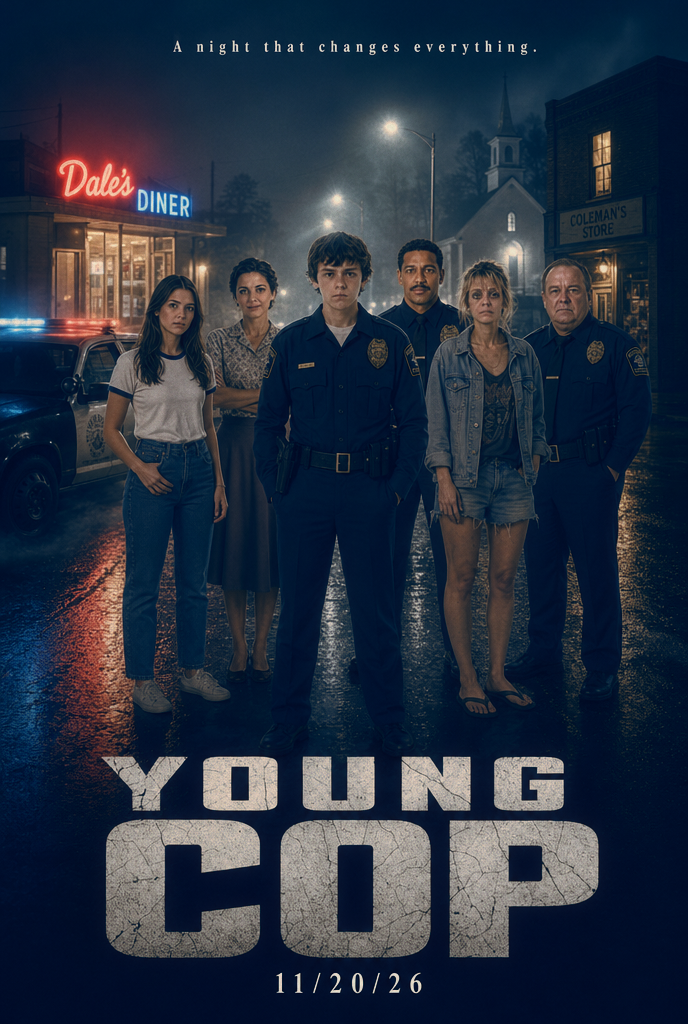
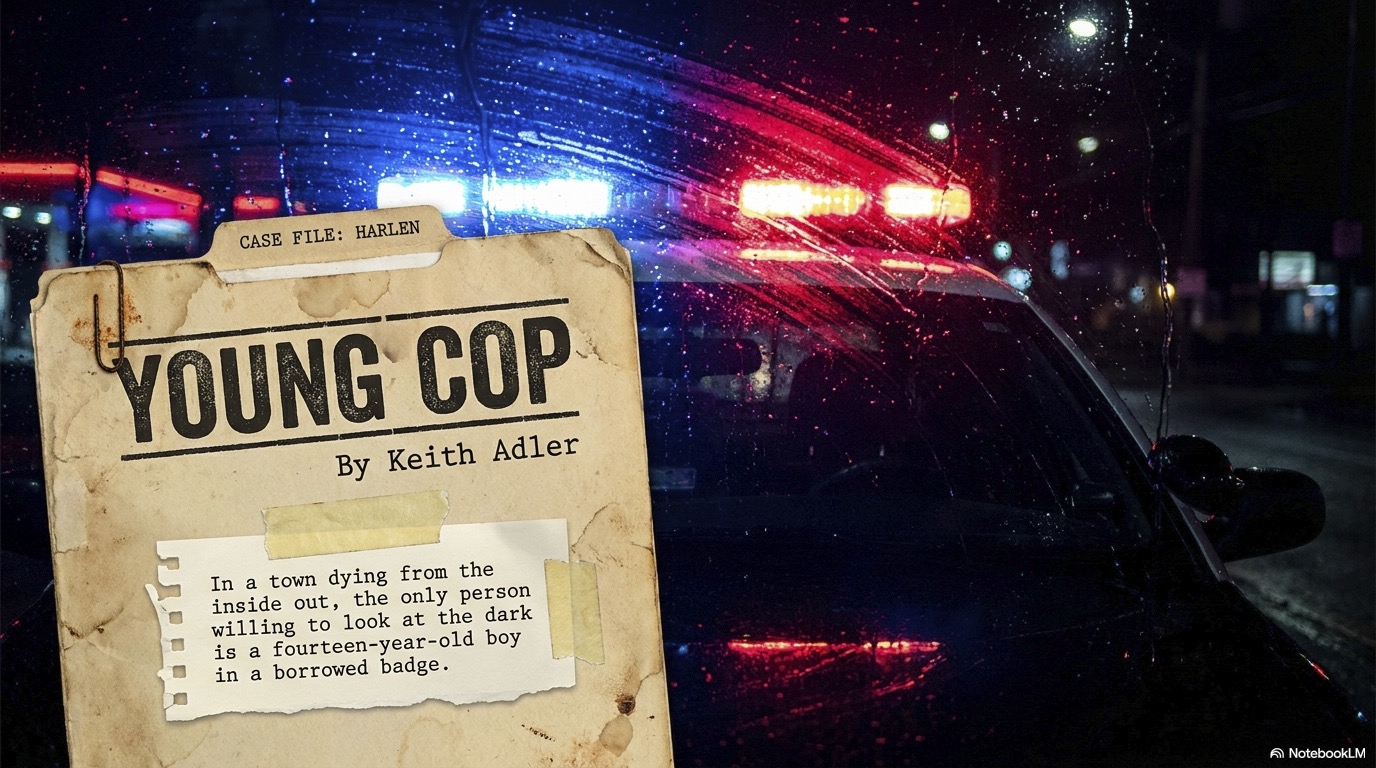
Princeton, Kentucky, 1985. The tobacco money is drying up and something new is moving in. Caleb Harlen is fourteen years old, orphaned, and driving the night patrol cruiser on a phone book for height. Nobody asked him to do this job. Nobody told him to stop. When a pattern of break-ins leads him to a drug operation protected by the people his town trusts most, he has to decide what the truth is worth, and whether a boy can carry it without breaking.
Rain falls on Princeton. Neon from the diner bleeds across wet pavement. Coleman's store sits dark. The school looms behind its chain-link. No one on the sidewalks. Friday night. The whole place holding its breath.
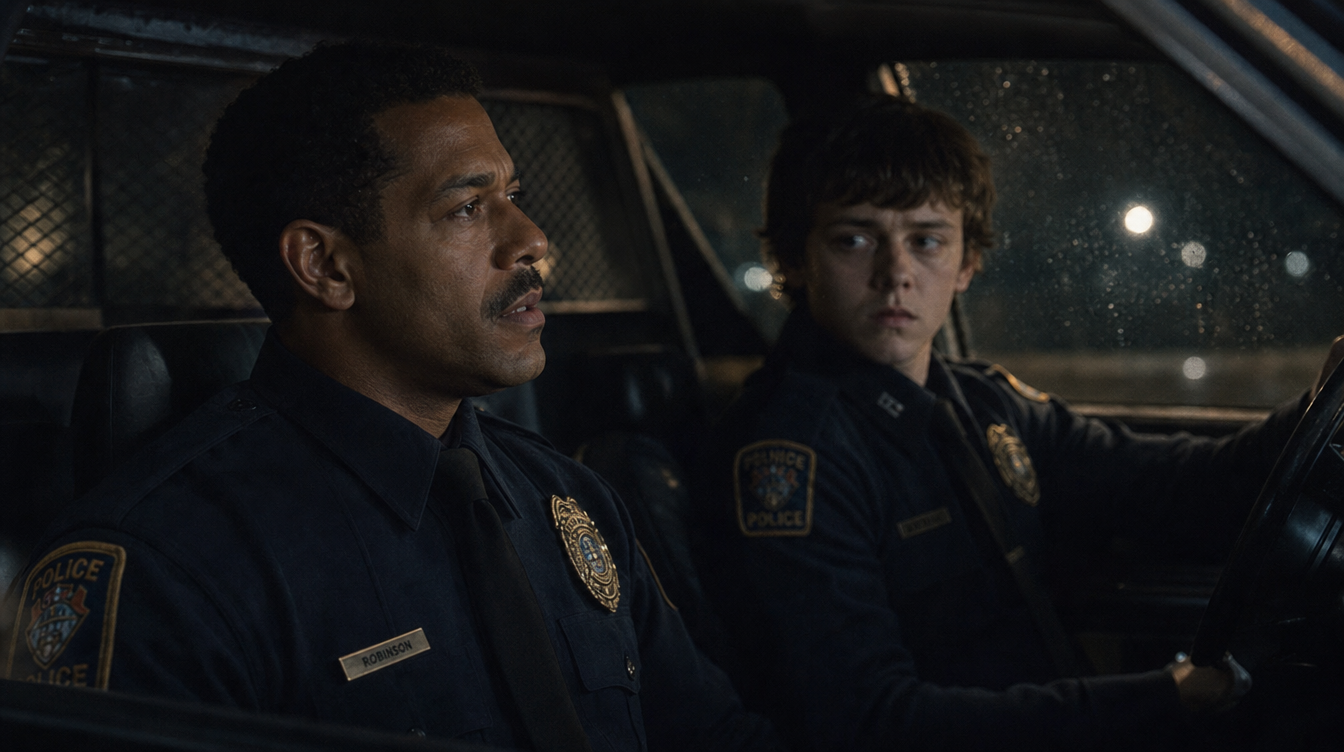
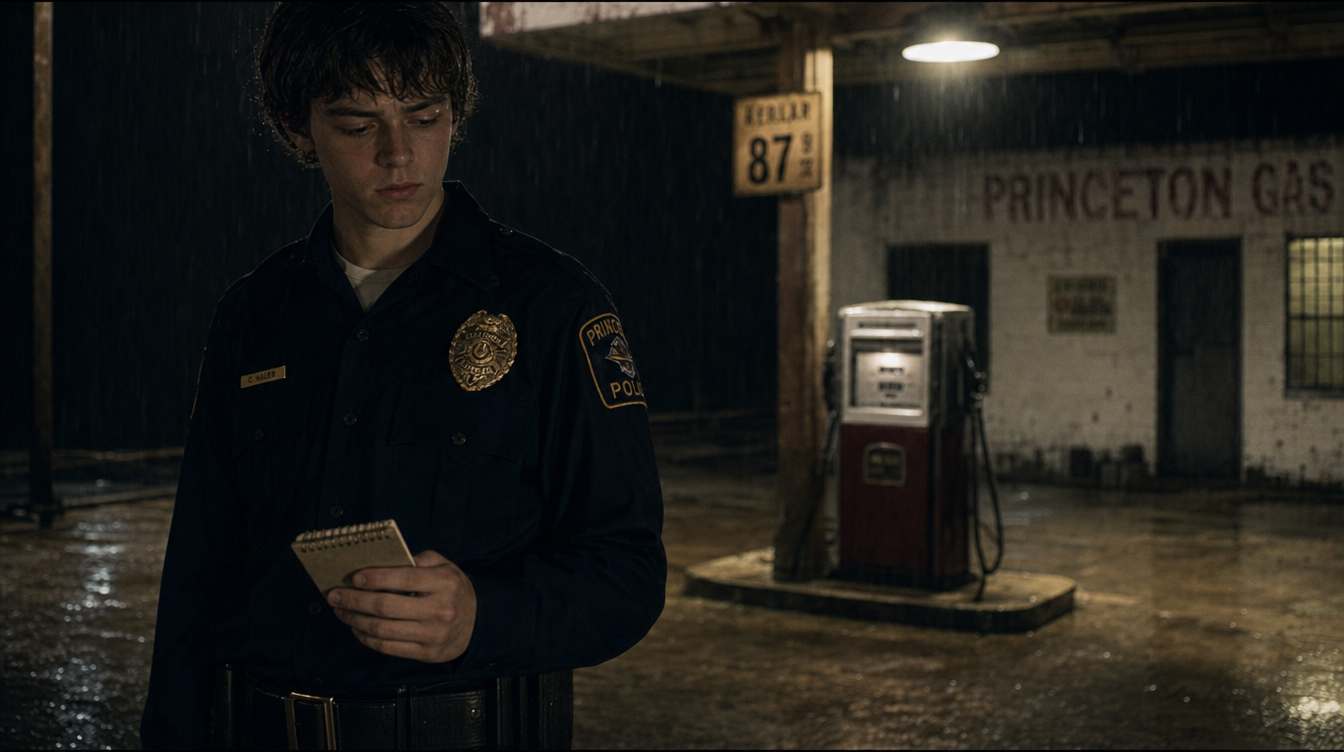
The cruiser rolls slow down Main Street, headlights cutting pale lines through the drizzle. Behind the wheel, a boy sits on a phone book so he can see over the dash. The uniform is two sizes too big. The badge catches the light from the instrument panel, and he touches it the way some people check a heartbeat - quick, automatic, just to make sure it's still there.
His name is Caleb Harlen. He is fourteen years old. And he is the only law this town has left after midnight.
This is the exact process I used. One person, no crew, under $7,000. If you have a story and a laptop, you can do this in 2026. Here is how, step by step. Every tool, every cost, every tip - documented so the next person can follow the same path. My goal is not just to make this film. It is to prove the map works so other creatives can use it.
STEP 1
Write the story
Tools: Any LLM for brainstorming (Gemini, Grok, NotebookLM). Your brain for the actual writing.
What you make: A novel or treatment first (to find the story), then a proper screenplay (to build the film from).
Time: 2-4 weeks for the novel. 2-3 weeks to convert to a shooting script.
Cost: $0 (free tiers are enough for brainstorming)
Tip: Write the novel first even if you only want a film. A novel forces you to know your characters completely. The screenplay is stronger because the novel existed. The novel is the sketch. The script is the painting. Use AI adversarially - not to write for you, but to stress-test what you wrote. Feed it your manuscript and ask it to find contradictions, dropped threads, and logic gaps. The story is yours. The AI is the cross-examination.
What you do: Play each piece on piano (or hum it, or write it out). Feed the recording into Suno as a seed. Direct the arrangement - tell it the instruments, the feel, the era. Iterate until the orchestra plays what you hear in your head.
What you make: A full original soundtrack, one track per major scene or emotional beat.
Time: 1-2 weeks for 8 tracks.
Cost: ~$96 (Suno Pro annual subscription)
Tip: Do this before production design. The music tells you how scenes feel. It will influence your visual choices later. Also: keep the piano audible in the mix. The human hand that started the piece should stay present in the final arrangement.
STEP 3
Build production design (characters, locations, props)
What you do: Write detailed character descriptions (age, build, clothing, distinguishing features). Generate reference sheets: front, side, detail shots. Lock these images - they become your consistency bible. Do the same for every location and every prop that matters.
What you make: A complete production design package. Every character, location, and prop visualized and locked.
Time: 1-2 weeks.
Cost: ~$200 (ChatGPT Plus subscription)
Tip: Consistency is the hardest problem. The model does not remember what your character looked like last time. You must include reference images in every prompt. Check every output against your locked references. If the nose changes, the hair shifts, the jacket color drifts - regenerate. This is where patience matters most.
What you do: Work scene by scene through your shooting script. Feed your locked character references and location images. Describe the shot: camera angle, movement, lighting, action. Generate. Review. Regenerate what doesn't work. Expect to generate 2.5+ hours of raw footage to get 80 minutes of usable material.
What you make: A complete rough cut of every scene in your film at 1080p.
Time: 3-4 months (this is the longest phase).
Cost: ~$3,000 for 2.5 hours of raw footage at ~$20/minute. That includes video generation, voice performances (ElevenLabs), and sound effects. 150 minutes of generated material to yield 80 minutes of final cut. The overage accounts for regenerations, alternate takes, and scenes that don't work on first pass.
Tip: Work linearly through the script. Do not jump around. Each scene teaches you something about prompting that the next scene benefits from. Your first scenes will be your weakest. That is fine. By scene 30 you will have developed a feel for what the model needs to hear. Also: the tools improve while you work. A scene generated in month 3 will look better than month 1 at no extra cost.
What you do: Create a unique voice for each character. Feed your dialogue line by line. Direct the performance - adjust pacing, emotion, age, accent. For narration/voiceover, use a separate voice that carries the story between scenes.
What you make: Every line of dialogue and narration as individual audio files, ready for editing.
Time: 2-3 weeks.
Cost: ~$250 (Pro subscription)
Tip: Spend time on voice selection before recording anything. A voice that sounds 90% right will bother you across 80 minutes. Find voices that are 100% right for each character. Also: the audiobook narration uses the same tool but a different voice than any character. Keep the narrator distinct.
What you do: Assemble your generated video scenes on the timeline. Layer in dialogue, narration, soundtrack, and sound effects. Adjust timing. Cut between shots. Add transitions where earned (most cuts should be hard cuts). Color grade if needed.
Sound effects:ZapSplat (real foley and ambiance). Crickets, car engines, radio static, door creaks, rain. Real sound effects ground AI visuals in reality. This is not optional.
Time: 2-3 weeks for assembly, 1-2 weeks for polish.
Tip: Sound is half the movie. An AI-generated frame with real cricket sounds and real rain ambiance feels 10x more believable than the same frame in silence. Invest time in your sound design. Also: DaVinci Resolve's free tier has everything you need for a feature film. You do not need to pay for editing software.
What you do: Export your finished edit at 1080p. Upload to a cloud GPU instance running Topaz Video AI. Upscale the entire film to 4K. The AI reconstructs detail, sharpens textures, and enhances the image far beyond simple upsampling.
Time: 25-30 hours of processing (runs overnight, unattended).
Cost: ~$200 (Topaz license) + ~$150 (cloud GPU time on Vast.ai with dual RTX 4090s)
Tip: 1080p source to 4K output is dramatically better than 720p to 4K. If your video generation tool offers 1080p, use it. The upscaler has 2.25x more data to work with and the result is visibly sharper. Run a test clip first to confirm settings before committing 30 hours to the full render.
STEP 8
Distribute
Platforms: Amazon Prime Video Direct (film), Amazon KDP (novel), your own website (everything else)
What you do: Submit the finished 4K film to Amazon Prime Video Direct. Publish the novel on KDP. Host your soundtrack, audiobook, and supplementary materials on your own site. Use Cloudflare R2 for media storage (pennies per month) and HLS adaptive streaming so viewers get quality matched to their connection.
Time: 1-2 weeks for submission and setup.
Cost: $0 (Amazon takes a revenue share, not an upfront fee)
Tip: You do not need festivals. You do not need an agent. You do not need permission. Amazon Prime Video Direct accepts independent submissions. If the quality is there, it goes up. The audience finds it or it doesn't - but it exists, and it is available, and nobody had to say yes for that to happen.
THE MATH
Total time: ~6 months working nights and weekends
Total cost: under $7,000
People required: 1
What you get: a novel, a screenplay, a soundtrack, an audiobook, and a feature film
The tools get better every month. The costs drop every month. What cost me $7,000 in 2026 will cost someone $2,000 in 2027. And someday it will cost $100. The democratization of filmmaking is not coming. It is here. You just have to have something to say.
The film is rendered natively at 720p, then upscaled to 4K using Topaz Video AI in the cloud. Cloud compute provided by Vast.ai, running two RTX 4090 instances simultaneously. Estimated upscaling time for the full movie: 25-30 hours. Estimated total cost for cloud compute and Topaz licensing: $450-$650.
The full film is chunked into 6-second HLS segments at multiple quality levels and served globally through Cloudflare's edge network. Zero egress fees. No third-party video platform. No ads. No tracking. Viewers get adaptive bitrate streaming that adjusts to their connection - hosted entirely on infrastructure we control, at near-zero cost.
DEVELOPMENT & WORKFLOW
Website and production pipeline developed by Keith Adler using Claude
Tech Stack
Runtime: Node.js 22 on Fly.io (single container, auto-sleep)
Server: Express.js - serves the SPA, API endpoints, authentication, sitemap, and dynamic meta tags for SEO
Frontend: Single-page application. Vanilla HTML/CSS/JS - no framework, no build step, no dependencies. One HTML file serves the entire public site
Data: Static JS modules (scenes, characters, locations, props, outfits) loaded client-side. JSON file for runtime state (approvals, cuts). No database
CDN: Cloudflare R2 for media storage (images, soundtrack MP3s, HLS video segments). Zero egress fees
Auth: Cookie-based session with bcrypt password hashing. Role-based access (admin/viewer)
Streaming: HLS adaptive bitrate - video chunked into 6-second segments at multiple quality levels, served from Cloudflare edge
DNS/SSL: Cloudflare (youngcop.com) with full SSL
Deployment: Docker container deployed via Fly CLI. Push to GitHub, fly deploy, live in 30 seconds
AI Development: All code written in partnership with Claude. No boilerplate generators, no templates - every line purpose-built for this project. This pipeline will form the basis of the next film
GOING FORWARD
This approach will be applied and improved on every future film. The goal is to go from thought to as many channels of storytelling as a story can carry. Novel, screenplay, soundtrack, film, audiobook. When the material earns it, build all of it.
By late July, when full film production begins, the tools will have improved again. Costs will drop and quality will increase. That's the trajectory these models are on, and timing production to ride that curve is part of the strategy.
Production Cost
ITEM
DATE
COST
✓ Novel
June 6
$0
✓ Soundtrack (Suno)
June 10
$96
✓ Script
June 15
$0
✓ Domain + Hosting (Fly.io)
June 20
$79
✓ Cloudflare R2 (CDN)
June 20
$15
✓ Film Prod Design (GPT)
June 21
$200
○ Teaser Trailer
July 4
~$400
○ Topaz Video AI (license)
July
~$200
○ Pop Theme Song
July 24
$0
Intended for Kickstarter support - mid July
○ Higgsfield (video gen)
Jul-Nov
~$600
○ ElevenLabs (voices)
Jul-Nov
~$250
○ Music Video
Aug 15
~$150
○ Official Trailer
Sep 13
~$750
○ Making Of
Oct 13
~$200
○ TikTok Series
Nov 13
~$400
○ Film (full production)
Nov 20
~$2,800
Goal: ~$5,300
○ TikTok Promotion
Oct-Nov
~$600
○ Amazon Publishing
Nov 20
~$0
○ Novel (Kindle Edition)
Nov 20
~$0
○ Audiobook (ElevenLabs)
Nov 20
~$260
SPENT SO FAR
$390
Est. Total: ~$7,000
Composed, performed, and produced by Keith Adler
Directed and realized through Suno
Licensed under Creative Commons BY-NC 4.0
Streaming only. Downloads available on supported platforms. Non-commercial use permitted with attribution.
SOUNDTRACK DISTRIBUTED BY DADDY CAN'T BUY U A HIT RECORDS
Chord Charts
A note for keyboardists
These are not chord charts in the way you are used to reading them. There is no lead sheet melody. No slash notation. No comping rhythm. What you are looking at is the harmonic skeleton of an orchestral arrangement - the root movement that the strings, brass, woodwinds, and piano collectively voice across each bar.
Each measure (separated by |) represents one bar at the given tempo and time signature. When two chords share a bar (like Asus4 A), the split is usually half and half unless the musical phrase tells you otherwise. Trust your ear.
Tips for following these on piano:
Voice the chords in the register the section implies. B sections (verse) sit in the mid-range - keep your hands around middle C. A sections (chorus) open up - spread your voicings wider, let the upper extensions ring. D sections (bridge) are departures - move your left hand down, give the bass room to breathe.
Sustained chords are not dead space. When you see four bars of Am, that is four bars of orchestral texture changing around a static harmony. On piano, let the chord decay naturally and re-voice it each bar - different inversion, different weight, different pedal depth.
The suspended chords (Asus4, Csus4, Bsus4) are load-bearing. Do not resolve them early. Hold the 4th. Let it ache. The resolution comes when the chart says it comes.
Slash chords (Bb/D, C/E, D/F#) are bass movement instructions. Your left hand walks while your right hand stays. This is how the orchestra creates motion without changing the harmonic color.
N.C. means no chord. Silence. Lift your hands. The hardest thing to play is nothing, and these pieces earn their silences.
Section letters: B = verse, A = chorus, C = pre-chorus, D = bridge
A Fourteen-Year-Old Boy Patrols a Dying Town Alone at Night. Nobody Asked Him To Stop.
A Southern noir feature film in the tradition of Stand By Me and Winter's Bone. Novel and soundtrack free under Creative Commons.
"Somebody has to be awake when this town isn't."
San Francisco - Young Cop is a Southern noir feature film set in Princeton, Kentucky, 1985. The tobacco money is drying up. Something new is moving in. Caleb Harlen is fourteen years old, orphaned, and driving the night patrol cruiser on a phone book for height. Nobody asked him to do this job. Nobody told him to stop.
When a pattern of break-ins leads him to a drug operation protected by the people his town trusts most, he has to decide what the truth is worth, and whether a boy can carry it without breaking.
Written, directed, and scored by Keith Adler, Young Cop uses AI tools to handle the production labor that would normally require a full crew. The story, the characters, and the creative decisions are human. The technology is the labor. The vision is the point.
The full release includes a novel, an audiobook, an 8-track original soundtrack, and the complete film. The novel and soundtrack are free for non-commercial use under Creative Commons BY-NC 4.0. The film is distributed commercially by Hollow House Films. Content advisory: drug use, threats against a minor, one overdose. No graphic violence or language. Appropriate for ages 13+.
All images currently available are pre-visualization concept art. (c) Keith Adler 2026. All Rights Reserved. The teaser trailer (July 4, 2026) will debut the final visual style, voice performances, and animation quality of the finished film.
The novel is available now. The teaser trailer drops July 4. The full film releases November 20, 2026. Everything lives at youngcop.com.
"This is a story about what morality costs when you're fourteen and you're the only one paying. That's what I wanted to make. Everything else is just how it got built."
- Keith Adler
Release Dates
Teaser Trailer: July 4, 2026
Trailer: September 13, 2026
Full Film: November 20, 2026
80-minute filmFull novelAudiobook8-track soundtrackNovel & Soundtrack: CC BY-NC 4.0Film: All Rights ReservedAll audiences
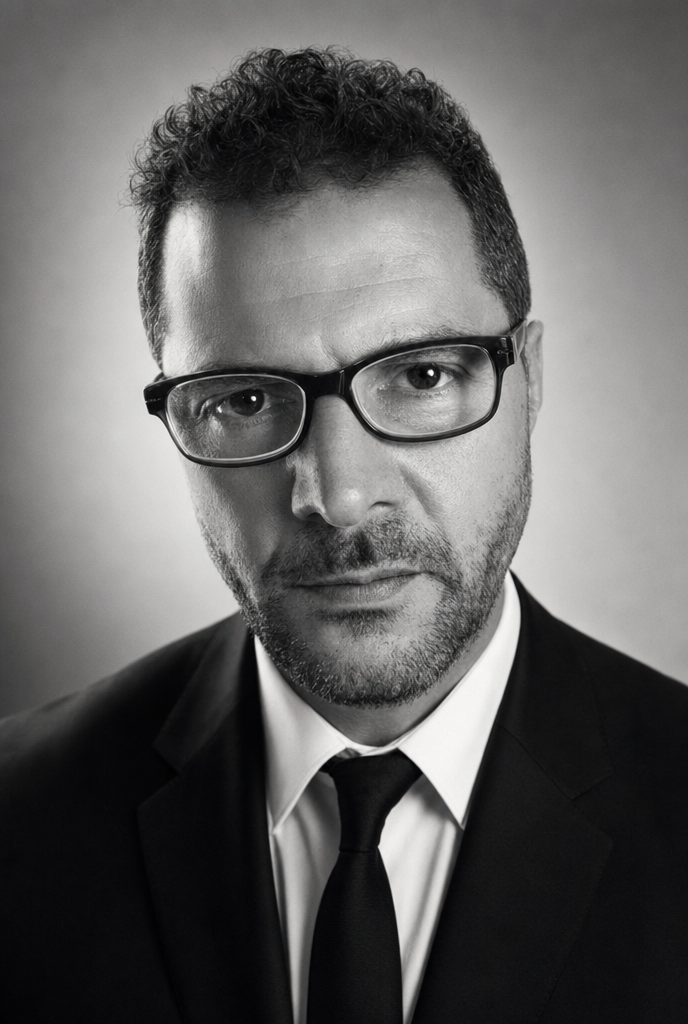
Keith Adler
Writer, Director, Producer, Composer San Francisco
Keith Adler is a hobbyist writer, filmmaker, and composer based in San Francisco. None of those are his profession. He works full-time in IT. He spent nearly a decade at a major entertainment company on the business and technology side, working across film and television at a senior level. During that time he attended industry events at every level of the business, from below-the-line production to Academy and guild functions, building a working understanding of how stories move from page to screen. Young Cop is his first feature. He wrote the novel, adapted the screenplay, composed the score, and is producing the film solo using AI as production labor under human creative direction. The film is made at night.
He drives the cruiser sitting on a phone book. The uniform is two sizes too big and the badge catches the light wrong. Fourteen years old, orphaned, performing adulthood so convincingly that the town forgot to stop him. He keeps a folder. He notices patterns. He won't look away, even when looking away is the only thing that might keep him safe.
His natural voice is higher - lighter - than the
one he uses on the radio. He's been practicing the
deep one since he was twelve. It works on the
scanner. In person, the illusion breaks.
(c) Keith Adler 2026. All rights reserved.
Marcus Robinson
Partner. The passenger seat.
His fingers never stop tapping a private rhythm on the car door. He dozes in the passenger seat but never actually sleeps. Made a promise once, after finding a kid behind the feed store. Keeps it every night. The closest thing to a father Caleb has. Nobody handed the boy a badge. Marcus just never took the keys back.
Marcus reaches into a paper bag on the seat.
Breaks a sandwich in half without a word.
Holds one half out. No eye contact. No
ceremony. Just: here.
(c) Keith Adler 2026. All rights reserved.
Erin
The one who stays.
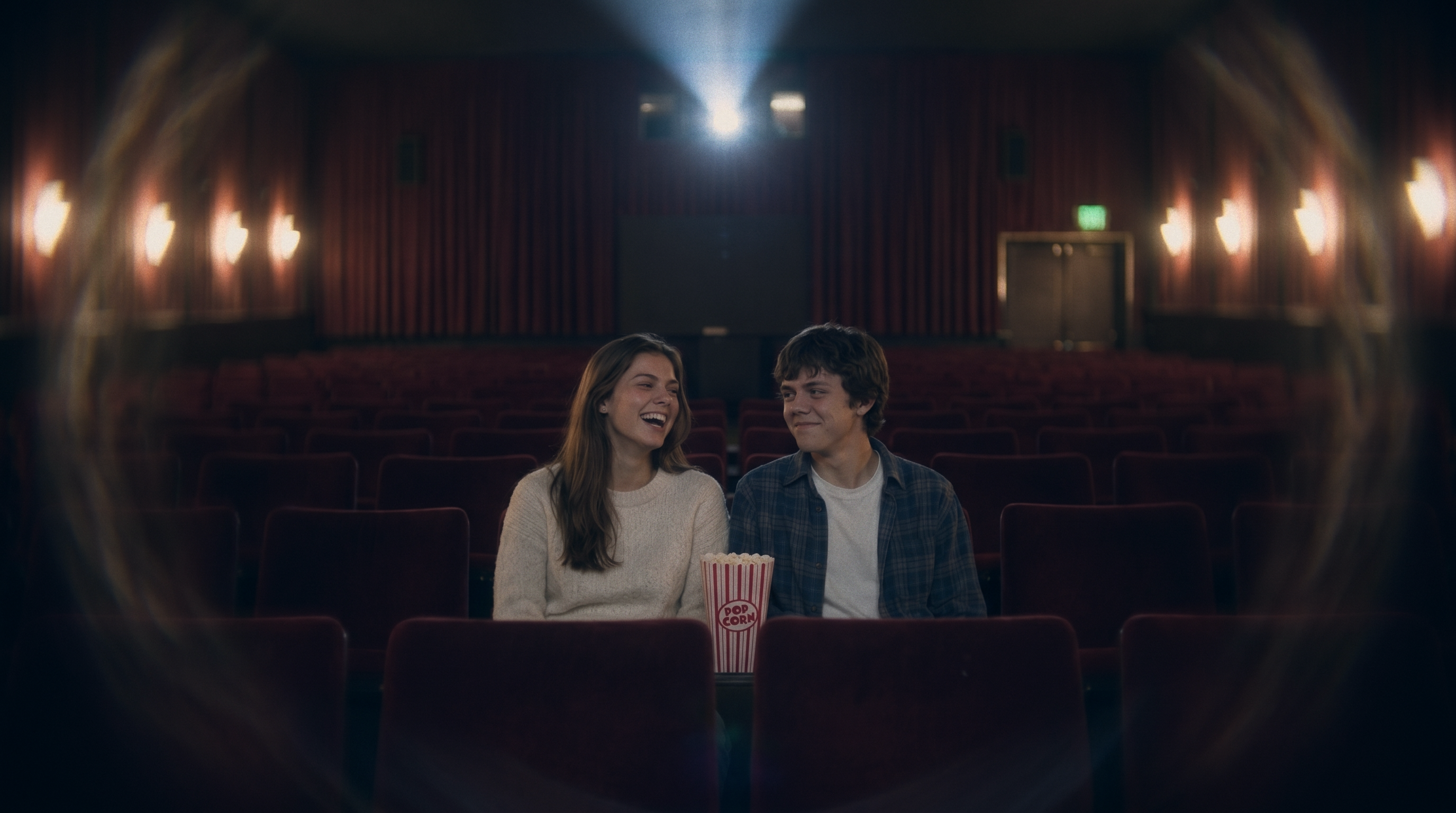
A reader who uses books as a bridge to people. Wins arguments. Gives him The Outsiders inscribed with two words that carry the whole film. She tried to pull him back to ordinary with paperbacks and Saturdays at the library, then accepted who he is and chose to stay anyway. The ball always rolls toward where she stood.
ERIN
Boo Radley had Scout. Who do you have?
(c) Keith Adler 2026. All rights reserved.
Miss Coleman
The light upstairs.
Runs the corner store. Sings in the church choir with a voice that carries. Divorced, no children of her own - fighting to adopt a boy the state says she has no claim to. The divorce makes it harder. Leaves the light on upstairs. Makes biscuits, tomato pie, chicken and dumplings. Patient until she isn't. The closest thing to unconditional.
MISS COLEMAN
My mama always said the quickest way to a
person's heart is through their stomach.
Guess I'm still trying.
(softer)
Eat something, Caleb. You look like you
haven't in days.
(c) Keith Adler 2026. All rights reserved.
Reno
The supplier.
Black leather jacket. Dark hair slicked back. Unlit cigarette behind his right ear. Drives a 1977 Trans Am with California plates. Face that might have been handsome before something went wrong behind the eyes. Speaks in threats dressed as jokes. Everybody's got someone they'd rather not lose.
RENO
You're the kid. The one with the notepad.
(c) Keith Adler 2026. All rights reserved.
Chief Dutton
The jacket stays on.
Princeton's police chief. Under-resourced, stretched thin. Mother in Shady Oaks at $2,400 a month. Wears his jacket even indoors, always ready to leave, never comfortable. Found a twelve-year-old idling in the cruiser one night and never told him to stop. Has been afraid of what the truth might cost him ever since.
DUTTON
You want me to call in the state boys on a
cut lock and a feeling? Tell them some
fourteen-year-old kid with a notepad thinks
we've got a pro working the same door every
third Friday?

CALEB
Yes sir.
(c) Keith Adler 2026. All rights reserved.
Bobby McClure
The disguise.
Coaches Little League. Goes to First Baptist. Known for fifteen years. New truck, paid cash. The kind of man nobody suspects because he looks like every other dad at the game. His nephew asked for twenty dollars for gas. His nephew doesn't have a car.
BOBBY
Most grown men I know wouldn't last a week
doing what you do. Just want you to know that.
(c) Keith Adler 2026. All rights reserved.
Tammy Dalton
The cost.
Once made Homecoming court. Still in there, barely. Five days and she aged five years. Calls Caleb 'deputy' and 'honey.' Grabs his arm in the alley and tells him what the new drug does to you. The canary in the coal mine, still singing.
TAMMY
Stay outta trouble. Both of you. This town's
too pretty for trouble.
(c) Keith Adler 2026. All rights reserved.
Free classroom resources for educators using the Young Cop novel
Read the full story the film is based on. Free under Creative Commons.
You have full permission to download, print, photocopy, and distribute the story to any students in your classroom. No additional licensing or fees required.
Open-ended questions for classroom or book club discussion. No answer keys - these are designed to invite multiple readings.
CHARACTER & IDENTITY
Caleb wears a uniform two sizes too big. How does this detail work as both a literal description and a metaphor for his situation?
Marcus never explains why he stays. What do his actions reveal about his motivations that words might not?
Caleb touches his badge "the way some people check a heartbeat." What does the badge represent to him? Does its meaning change over the course of the story?
Erin gives Caleb a copy of The Outsiders. Why that book? What parallels exist between the two stories?
MORALITY & CHOICES
Caleb carries a gun but reaches for the folder first. What does this tell us about how he defines justice?
Chief Dutton knows more than he acts on. Is he a coward, a pragmatist, or something else entirely?
Bobby McClure is described as "the kind of man nobody suspects." What does the novel say about how communities enable harm through trust?
At what point does Caleb's refusal to look away stop being brave and start being dangerous? Does the novel draw that line?
COMMUNITY & PLACE
Princeton is described as "dying" throughout the novel. What is killing it? Is the town a victim, a participant, or both?
The story takes place in 1985 Kentucky during the early drug crisis. How does the specific historical moment shape the characters' choices?
Miss Coleman "never asks questions. Never goes anywhere." How does her form of love differ from Marcus's? Which does Caleb need more?
The novel opens and closes at night. What does darkness mean in this story beyond the literal?
THEMES & CRAFT
The novel is described as "Southern noir." What elements of noir are present? How does the Southern setting change or complicate the genre?
Tammy Dalton is called "the canary in the coal mine, still singing." Discuss how the novel treats addiction - as a character flaw, a systemic failure, or something else?
Faith is listed as a central theme, but the novel isn't religious in a traditional sense. What kind of faith is the story about?
If Caleb is the moral center of the novel, what does the story argue about where morality comes from? Is it taught, inherited, or chosen?
ENGLISH LANGUAGE ARTS
Southern Gothic literature tradition
First-person narration & unreliable perspective
Symbolism and motif (badge, uniform, night)
Character development through action vs. exposition
Comparative texts: The Outsiders, To Kill a Mockingbird, Flannery O'Connor
SOCIAL STUDIES & HISTORY
1980s America: Reagan era, small-town economics
The early drug crisis in rural Appalachia
Policing in under-resourced communities
Foster care system & child welfare
Deindustrialization & rural decline
ETHICS & PHILOSOPHY
Moral courage vs. self-preservation
Duty to community vs. duty to self
When does a child become responsible?
Complicity through silence
Justice vs. law
MEDIA & FILM STUDIES
Adaptation: novel to screenplay to film
AI as production tool - authorship questions
Sound design & emotional cueing
Visual storytelling & cinematography
Independent filmmaking economics
Creative Writing Prompts
Inspired by the world of Young Cop. Use these as starting points for short stories, journal entries, or longer work.
PROMPT 1 - POINT OF VIEW
Write the opening chapter of Young Cop from Marcus's perspective. What does he see when he looks at Caleb? What does he think about but never say?
PROMPT 2 - PLACE AS CHARACTER
Write a short story set in a small town that is dying. Don't name the disease killing it. Let the reader figure it out through details: what's closed, what's changed, what people don't talk about anymore.
PROMPT 3 - THE UNIFORM
Write about a character wearing something that doesn't fit them - literally or figuratively. A job title, a family role, a piece of clothing. How do they make it theirs anyway?
PROMPT 4 - THE FOLDER
Caleb keeps a folder of patterns he notices. Write a scene where a character discovers a truth by paying attention to small details everyone else ignores. Don't let them explain it out loud - show the realization through action.
PROMPT 5 - NIGHT SHIFT
Write a complete short story that takes place entirely between midnight and 5 AM. Everything important happens in the dark. Use sound more than sight.
PROMPT 6 - THE PERSON NOBODY SUSPECTS
Write a character sketch of someone hiding something. The reader should know something is wrong by the end of the first paragraph, but the other characters in the story shouldn't suspect until much later. How does trust become a disguise?
PROMPT 7 - ADAPTATION
Take a scene from the Young Cop novel and rewrite it as a screenplay. What internal thoughts do you lose? What visual details do you gain? What stays the same?
PROMPT 8 - TWENTY YEARS LATER
Write a scene set in Princeton, Kentucky in 2005. Caleb is 34. What does the town look like now? Is he still there? What does he do when he drives past the old police station?
Film Study Guide
For use after viewing the film (available November 20, 2026). Compare the film to the novel and explore how adaptation changes storytelling.
PRE-VIEWING
Read Chapters 1-3 of the novel before watching. Note specific sensory details (sounds, smells, textures). How do you expect these to be shown on screen?
Listen to the soundtrack track "Ten and Two" without context. What images does it create? What mood? Return to this after viewing.
Research: What was happening in rural Kentucky in 1985? What industries were dying? What was arriving?
DURING VIEWING - OBSERVATION NOTES
Track how the film shows Caleb's internal thoughts without voiceover. What visual techniques replace prose narration?
Note every scene where the camera stays on a character's face without dialogue. What is being communicated?
Count the number of scenes that take place in darkness vs. daylight. What does this ratio tell you?
Listen for the character musical motifs. When does Caleb's theme play? When is it absent?
POST-VIEWING DISCUSSION
What scenes from the novel were cut? Why do you think they were removed? Does the film suffer for it or gain focus?
The novel lets you hear Caleb think. The film can't. How does the adaptation solve this problem?
Compare the opening of the novel to the opening of the film. Same scene? Same tone? What changed and why?
Sound design: Identify three moments where sound effects (not music, not dialogue) carry emotional weight. What are they doing that visuals alone couldn't?
The film was made by one person using AI tools. Does knowing this change how you experience it? Should it? Why or why not?
COMPARATIVE ANALYSIS ESSAY TOPICS
Compare the depiction of Princeton in the novel vs. the film. How does each medium create a sense of place?
Analyze Marcus's character across both forms. What do you learn from prose that film can't show? What does film reveal that prose can't?
The novel uses weather as mood. Analyze how the film uses lighting, color grading, or sound to achieve the same effect.
Argue for or against: "AI-generated visuals are a valid artistic medium for serious storytelling." Use specific scenes from the film as evidence.
All materials free under Creative Commons BY-NC 4.0
YOUNG COP
Production Access
Terms of Use
Last updated: June 26, 2026
1. Ownership
All content on this website, including but not limited to the screenplay, novel, soundtrack, characters, character designs, locations, props, scene descriptions, dialogue, story elements, and all associated visual and audio materials, is the original intellectual property of Keith Adler.
The novel and soundtrack are provided under CC BY-NC 4.0.
The screenplay and finished film are All Rights Reserved. The film is distributed by Hollow House Films. The soundtrack is distributed by Daddy Can't Buy U A Hit Records. No reproduction, distribution, or adaptation permitted without written permission.
Attribution - You must give appropriate credit to Keith Adler, provide a link to the license, and indicate if changes were made.
Non-Commercial - You may not use the material for commercial purposes including monetized videos, merchandise, or any revenue-generating activity.
3. Commercial Licensing
Any commercial use requires a separate paid license. Contact contact@youngcop.com.
4. Prohibited Uses
Reproducing without attribution · Derivative commercial works · AI training without permission · Scraping or bulk downloading · Removing copyright notices · Claiming authorship
We collect minimal data. We use Google Analytics to understand how visitors find and use the site. No advertising. A session cookie is set only when you log in. Server logs are retained for 30 days max.
What We Collect
Server logs (IP, browser, timestamps) for security only. One session cookie for login. Google Analytics collects anonymized usage data (pages visited, time on site, referral source) to help us understand traffic. No names, emails, or payment info collected through the site.
Third Parties
Google Analytics (usage data, anonymized). Cloudflare (CDN) and Fly.io (hosting) process requests. No data is sold or shared for advertising purposes.
Your Rights
We do not sell personal information. California (CCPA) and EU (GDPR) rights are respected. Contact contact@youngcop.com for any data requests.
Disclaimer
Last updated: June 26, 2026
No Affiliation
Young Cop is an independent production with no affiliation, sponsorship, or endorsement from Adobe, Amazon, Anthropic, Apple, Blackmagic Design, Cloudflare, ElevenLabs, Fly.io, Google, Higgsfield, Kickstarter, OpenAI, Pontiac, Seedance, Suno, Topaz Labs, Vast.ai, xAI, or ZapSplat.
Distribution
The film is distributed by Hollow House Films. The soundtrack is distributed by Daddy Can't Buy U A Hit Records. Both are entities of Keith Adler.
Creative Responsibility
All creative decisions are the sole responsibility of Keith Adler. AI tools are instruments of production, not collaborators.
AI Content Disclosure
Visual content on this site is generated or assisted by AI tools. No AI content depicts real persons or events. All imagery represents fictional characters from the screenplay.
Fictional Content
Young Cop is a work of fiction. Any resemblance to actual persons or events is coincidental.
Accessibility
Last updated: June 26, 2026
We strive to conform to WCAG 2.1 Level AA. The site uses semantic HTML, alt text, keyboard navigation, sufficient color contrast, and responsive design.
Known Limitations
Some concept art may lack full alt descriptions. The soundtrack player doesn't yet announce track changes to screen readers. Some animations may not respect reduced-motion preferences.
We do not sell or share your personal information.
This website does not sell personal information to third parties, use advertising trackers, collect information for profiling, or share data for behavioral advertising.
This site uses a session cookie for login only. No tracking or advertising cookies. Privacy Policy
Production Cost
ITEM
DATE
COST
✓ Novel
June 6
$0
✓ Soundtrack (Suno)
June 10
$96
✓ Script
June 15
$0
✓ Film Prod Design (GPT)
June 21
$200
✓ Domain + Hosting (Fly.io)
June 20
$79
✓ Cloudflare R2 (CDN)
June 20
$15
○ Teaser Trailer
July 4
~$400
○ Pop Theme Song
July 24
$0
Intended for Kickstarter support - mid July
○ Higgsfield (video gen)
Jul-Nov
~$600
○ ElevenLabs (voices)
Jul-Nov
~$250
○ Topaz Video AI (license)
July
~$200
○ Vast.ai (4K upscale)
Oct-Nov
~$150
○ Music Video
Aug 15
~$150
○ Official Trailer
Sep 13
~$750
○ Making Of
Oct 13
~$200
○ TikTok Series
Nov 13
~$400
○ Film (full production)
Nov 20
~$2,800
Goal: ~$5,500
○ TikTok Promotion
Oct-Nov
~$600
○ Amazon Publishing
Nov 20
~$0
○ Novel (Kindle Edition)
Nov 20
~$0
○ Audiobook (ElevenLabs)
Nov 20
~$260
SPENT SO FAR
$390
Est. Total: ~$7,000
License Agreement
Silence as Force: How Young Cop Uses What You Don't Hear
In Young Cop, silence is not merely an absence of sound or dialogue. It is a deliberate structural, narrative, and musical tool used to convey moral weight, isolation, and dread. It is weaponized.
The soundtrack is designed around silence. Pieces build at relentless tempos before dropping abruptly into absolute silence - notated as 'N.C.' (No Chord) in the score. When diegetic sound vanishes completely in the film's most critical moments - sirens, radios, boots on gravel, all gone - the audience is forced to feel the weight of what is happening without the comfort of noise to hide behind. What remains in that void is more devastating than anything a full orchestra could deliver.
Marcus, Caleb's partner, maintains a constant private rhythm by tapping his fingers on the cruiser door. It acts as a steady heartbeat for both characters and for the audience. You stop noticing it is there. And then it stops. When Marcus stops tapping, the resulting silence signals that the shield of routine has dropped and a heavy truth is entering the space. The absence of a sound you forgot you were hearing is more alarming than any sudden noise.
The screenplay was explicitly designed to replace the novel's internal monologues with visual silence. A script describes a silence. The film is the silence. By removing Caleb's internal voice, the film forces the audience to experience his isolation visually and aurally. Silence on a page is just white space. Silence on a screen, with a boy's breathing and the sound of rain on tin, is something else entirely.
This environmental silence surrounds Caleb throughout the film. The particular silence of a house that remembers more people than currently live there. The suffocating quiet of late nights alone. The silence of a town asleep while a fourteen-year-old watches its doors. The silence between two people in a cruiser who both know something is wrong and neither will say it yet.
From the script:One lamp burns in the hall. Kitchen bulb dead for
weeks. Wallpaper curling at the edges. In the living
room: a TV set - big wooden console, the kind that's
also furniture - screen dark. He doesn't turn it on.
Hasn't in weeks. The house is quieter without the
voices pretending someone's home.
The ANSWERING MACHINE gives its usual empty click.
Red light blinking. Nothing.(c) Keith Adler. All rights reserved, existing and future.
No music. No dialogue. A dead bulb, a dark TV, an answering machine that clicks and says nothing. The silence of a house that used to have people in it and doesn't anymore. That is what silence looks like when it has weight.
Silence in most films is a pause. In Young Cop it is pressure. It is the weight of what is not being said, not being done, not being heard. It is the space where the audience's own fear fills the gap. And that is always worse than whatever sound the film could give you instead.
The Audience Does the Work. That's the Point.
I want to talk about what this film asks of the person watching it. Because it asks something. It is not passive entertainment. It is not going to tell you how anyone feels.
When Erin's pen cap snaps in her hand on the porch, there is no music cue that says 'this is the moment she breaks.' When Caleb's thumbnail tears raw under the table, nobody explains that he is terrified. You see the pen cap. You see the thumbnail. You do the math yourself. And because you did the math, you feel it in your body instead of your head. It transfers from intellectual to visceral. That is the design.
Most films hand you the emotion pre-digested. A character says 'I'm scared' and swelling strings confirm it. You sit back. You receive. You are passive. In Young Cop, you get trembling hands and a thermos label peeled into tiny curls and a boy who won't press the radio button. You have to lean in. You have to actively participate to infer the emotional math. And the moment you do that work, you are pulled inside the story in a way that no exposition dump can achieve.
From the script - physical behavior as emotional information:He touches it - two fingers, same spot, brief - the
way other people check a heartbeat. A ritual. Every
shift starts this way.
His eyes never stop moving. The dark storefronts.
The parked cars. The places where the streetlights
don't quite reach. His posture is too straight.
His grip too tight.(c) Keith Adler. All rights reserved, existing and future.
Nobody says 'Caleb is anxious and needs reassurance.' You see a kid touch a badge like a rosary and grip the wheel until his knuckles ache. You infer the rest. And because you inferred it, you own it.
Dialogue in this film operates as physical action. It lives within the constraints of 1985 rural Kentucky. There are no cell phones. No texts. No instant communication. If Caleb needs to warn someone, he has to drive there. If Bobby needs to take a call, he crosses an empty parking lot to a payphone on a pole. This is not about cool synths or Stranger Things nostalgia. The 1985 setting creates technological friction through the absence of modern convenience. That friction makes the human act of communication into a barrier. Every conversation costs time, distance, and exposure. Moving, speaking, hiding - all of it is harder. Delay is not dead time. Delay is tension.
In Princeton, Kentucky in 1985, if you want to tell someone something, you have to be in the same room. If you want to know what someone is doing on a Friday night, you have to watch them. If you want to warn a kid he is in danger, you fold a note and walk it to his house in the dark. The resolution to every problem requires physical presence and personal risk. That is what makes the words in this movie heavier. Every line of dialogue was earned by someone choosing to show up and say it out loud.
And then there is the shared context. These people have known each other for decades. They do not explain their history to each other. Gene does not tell Earl who Bobby is. Marcus does not tell Caleb what it means to be the only Black officer on a three-man force in rural Kentucky in 1985. Miss Coleman does not explain why she has been alone for fifteen years. The audience is trusted to follow. Trusted to dig for their own bearings. Trusted to notice what is not said and understand why.
From the script - dialogue as shared history with zero exposition:MARCUS
Mrs. Greer still hasn't fixed that porch light.
CALEB
Checked on her Tuesday. She said she'd call
her nephew.
MARCUS
You check on her every Tuesday?
CALEB
She makes cornbread.
MARCUS
(offended)
I've been driving this route for six years.
I never got cornbread.
CALEB
You never checked her porch light.(c) Keith Adler. All rights reserved, existing and future.
Nobody explains who Mrs. Greer is or why she matters. Nobody tells you this is a town where an old woman leaves cornbread on a porch for a fourteen-year-old who checks her house at midnight. You figure it out. And the warmth of that community lands harder because you assembled it yourself.
This is how real people talk. In half-sentences. In shared references. In looks across a diner booth that carry thirty years of context. The film respects that. It does not stop to teach you the town. It drops you in and trusts you to swim.
If you want a movie that tells you what to feel, this is not it. If you want a movie that makes you do the work and rewards you for paying attention, this is the one.
1080p Is the New Baseline. Here's What That Means for the Film.
When I started production design in May, Higgsfield Cinema Studio generated at 720p. That was the ceiling. Every frame of the film was planned around a 720p-to-4K upscale pipeline using Topaz Video AI. The math was simple: generate at 720p, upscale 4x, deliver at 4K.
That math just changed. Higgsfield Cinema Studio 2.0 and now 3.0 output at up to 4K natively. But more importantly for this project, 1080p generation is now fast, cheap, and visually superior to what 720p looked like even two months ago. The cost per minute of AI video generation has dropped roughly 40% since I started.
What does 1080p source material mean for Topaz upscaling? Everything. Topaz Video AI reconstructs detail from what it has. Give it 720p and it has to invent a lot. Give it 1080p and it has 2.25x more pixel data to work with. The 4K output from a 1080p source is sharper, more detailed, and has fewer artifacts than 4K from 720p. Skin texture holds. Text is legible. Fabric weave is visible. It is a meaningful, visible improvement.
The practical impact: I am regenerating key scenes at 1080p for the teaser trailer. The full film production starting in late July will generate entirely at 1080p. The Topaz upscale to 4K will be cleaner, faster, and require fewer passes. Estimated cost savings on compute: 15-20%, because fewer frames need re-generation for quality issues.
This is the curve I talked about in earlier posts. Every month the tools get better and cheaper. The teaser trailer on July 4 will be pure 1080p source upscaled to 4K. That is the final pipeline. By the time the full film hits screens in November, the quality gap between this and a traditionally shot indie will be smaller than anyone expects.
Total estimated cost change for the 4K pipeline: down from $450-$650 to approximately $350-$500. Same quality. Actually, better quality. Less money. That is the trend line. And it is not slowing down.
Adobe Just Bought Topaz Labs. Here's What That Means for Young Cop.
Today Adobe announced a definitive agreement to acquire Topaz Labs, the AI video and image enhancement company whose tools are a core part of this film's production pipeline.
Topaz Video AI is how Young Cop gets from 720p (the native output of Higgsfield Cinema Studio) to 4K delivery. Every frame of the finished film will pass through Topaz's upscaling models before final export. It's not optional. It's load-bearing infrastructure.
So what does an Adobe acquisition mean for this project? In the short term: nothing changes. Topaz's standalone tools will continue to work as they do today. The deal isn't expected to close until the second half of 2026, and CEO Eric Yang is staying on to lead the team. My production timeline (trailer July 4, full film November 20) fits well within that window.
In the longer term: this is validation. Adobe doesn't acquire tools that don't work. Topaz's AI enhancement models are now considered essential infrastructure for professional creative work. That's exactly how I've been using them. The tool I chose for upscaling an indie AI film just got bought by the largest creative software company on the planet.
There's also a practical upside. If Topaz's models eventually integrate into Adobe's Creative Cloud or DaVinci Resolve plugins, the workflow gets simpler. Right now I'm running Topaz on cloud GPUs through Vast.ai. If that becomes a one-click operation inside the editing suite, future projects get faster and cheaper.
For now: the pipeline holds. Topaz Video AI remains the tool. The 4K upscale strategy is unchanged. And the fact that Adobe validated this specific technology on the same day I'm building a film with it feels like confirmation that the approach is sound.
The Script Is the Real Version. The Novel Was the Sketch.
I want to be honest about something. The novel was first. It was necessary. But the screenplay is the version of this story that actually lives.
The novel was me figuring out who these people are. Writing their internal monologues, living inside Caleb's head, exploring every corner of the town at my own pace. It served its purpose. It let me find the story without a camera watching.
The script is what the story became once I stopped explaining it and started showing it. Every scene was earned. Every line of dialogue was pressure-tested. If a character's interior thought couldn't become visible behavior, it got cut. If a V.O. line told the audience something the image already showed, it got cut. What remained felt more alive to me than the novel.
Specific things the script does that the novel doesn't: Marcus's silence when his tapping stops. The doodle on the notepad during the stakeout. Coleman bowing her head over French toast. Erin's pen cap snapping in two. These are not in the book. They emerged in the adaptation because a screenplay forces you to make interior life into exterior action. That process made the story better.
From the script - a voice on a radio that tells you everything about a boy pretending to be a man:CALEB
(into the radio - his voice pitched low on
purpose, the way he's trained himself to
sound on the air)
Yes ma'am. All clear on Main. Heading south
on 91.
He releases the button. His natural voice is
higher - lighter - than the one he uses on
the radio. He's been practicing the deep one
since he was twelve. It works on the scanner.
In person, the illusion breaks.(c) Keith Adler. All rights reserved, existing and future.
The novel tells you Caleb feels like a fraud. The script shows you a kid pressing a radio button and deepening his voice. One is a thought. The other is a performance you watch collapse in real time.
And here - interior life made visible through a single physical gesture:She sits across from him. Bows her head. Eyes
closed. Three seconds. Her lips move - nothing
he can hear. Then she opens her eyes, picks up
her coffee, and nods once at the plate.
He eats. She sits across from him with her
coffee and the Sunday paper and doesn't say a
word. The radio plays. The sun moves across
the table between them.(c) Keith Adler. All rights reserved, existing and future.
In the novel, Coleman's love is described in paragraphs of backstory. In the script, it is a three-second prayer and a nod at a plate. That is what adaptation does. It finds the one gesture that carries the weight of a thousand words and trusts the audience to feel it.
The novel is free. Read it. It's the foundation. But if you want to know what this story really is at its best, the film is the answer. The script is 79 scenes of a story that has been rewritten, pressure-tested, and refined until I believe every beat earns its place. The novel was the first draft of the soul. The script is the finished house.
And the film will rise above the script the same way the script rose above the novel. A script describes a silence. The film is the silence. A script says the rain falls on tin. The film is the sound of it. A script notes that Marcus taps a rhythm on the door. The film is that rhythm in your chest.
Each form elevates the last. The novel found the people. The script gave them bones. The film gives them breath. By the time you hear a fourteen-year-old voice crack on the radio, or see Coleman's face when she bows her head, or feel the exact weight of three seconds of silence between Reno and Caleb in the mud, you will not be reading a story. You will be inside one.
We're Months Away from Story-to-Screen for Under $100. What Does That Mean?
I believe we are a matter of months away from being able to go from story to script to multiple distribution channels at a cost of under $100. And perhaps in the future, under $1.
Think about that for a moment. A complete narrative - written, scored, voiced, animated, edited, and distributed - for less than a nice dinner. The tools are converging fast. Video generation improves every month. Voice synthesis is already indistinguishable. Music generation from a simple prompt or a piano melody is here today. Editing software is free. Distribution is a URL.
What does this mean for Hollywood? For the studio system? For the thousands of people whose livelihoods depend on the current model of production? These are real questions and they deserve honest answers, not hype.
There is legitimate concern about quality. When the barrier to creation drops to zero, the volume of content explodes. Most of it will be bad. Most of it will be derivative, rushed, or soulless. That is a real risk and it would be dishonest to pretend otherwise.
But in the end, audiences will decide. They always have. They chose television over radio. They chose streaming over cable. They chose YouTube over network programming. Not because those things were cheaper to make - but because the best of them were worth watching. The cream rises. It always has.
The question is not whether AI-generated film will replace traditional production. The question is whether a single person with a story, a laptop, and $100 can make something that moves an audience the way a $200 million production does. I believe the answer is yes - not because the technology is magic, but because storytelling is human. The tools change. The craft does not.
We are about to find out.
Building the Trailer, Planning the Kickstarter: What Comes Next
Right now I'm deep in trailer production. The goal is a full-length teaser trailer that demonstrates the story and the artistic vision using the full technology workflow: Higgsfield for video generation, ElevenLabs for voice, Suno for music, DaVinci Resolve for editing, real sound effects for grounding. A trailer that shows what this film looks and feels like when all the pieces come together. Targeting July 4.
If the trailer proves the concept the way I believe it will, I'm taking Young Cop to Kickstarter. Not to fund distribution - that's Amazon, and it's free. The Kickstarter funds production: the AI compute, voice generation, cloud rendering, and upscaling that turn a script into a finished film. The total budget is under $7,000. The campaign covers the remaining costs I haven't already spent out of pocket.
Planned tiers: Executive Producer credit in the finished film. Associate Producer credit. Special Thanks in the credits. A Name a Character tier where backers can name a non-protagonist, non-antagonist character in the film. Names must be realistic and appropriate, and I reserve approval. And a Background Appearance tier where backers can appear visually in the film as a background character. No speaking parts, but you'll be in the movie. It's a way to put a piece of yourself into the story permanently.
The film releases on Amazon Prime Video Direct on November 20. The Kickstarter is how it gets made. Amazon is where it lives.
One more thing worth noting: by late July, when full film production begins, the underlying models will have improved again. Every month, the quality goes up and the cost per generation goes down. I'm timing production to ride that curve. The film I make in August will look better and cost less per minute than anything I could produce today.
More details once the trailer is finished and I can show rather than tell. For now: the work continues every night.
Here is the opening of the teaser trailer script - everything up to the first cut to black:BLACK.
HOLLOW HOUSE FILMS logo. Fades in.
Holds two seconds. Fades out.
BLACK.
A KEITH ADLER STORY AND FILM
Holds two seconds. Fades out.
MUSIC: "Ten and Two" - opening piano only.
Dm. Sparse. One hand.
BLACK. Rain on metal.
CALEB (V.O. - OLDER)
Friday night. Fourteen. The town smells
like wet asphalt and nothing's open.
FADE IN:
INT. POLICE CRUISER - NIGHT
Hands at ten and two. A phone book on the
seat. The badge catches the dash light.
Two fingers touch it. Brief.
MUSIC: Strings enter beneath the piano.
Still quiet.
EXT. PRINCETON - NIGHT
The cruiser rolls. Neon bleeds across wet
pavement. No one on the sidewalks. A dog
lifts its head from a porch. Doesn't bark.
Goes back down.
MARCUS (V.O.)
Nobody handed you a badge, Harlen. You just
kept showing up until the badge was the only
thing that made sense.
CUT TO BLACK. One beat.(c) Keith Adler. All rights reserved, existing and future.
The rest is fully scripted - 90 seconds of scored, shot-listed teaser with music cues from the original soundtrack. In the pipeline for July 4th.
Editing Young Cop in DaVinci Resolve: Why Free Tools Are Enough for a Feature Film
The edit is happening in DaVinci Resolve. The free version. No subscription, no watermarks, no limitations that matter for this project. It handles everything I need: multi-track timeline, audio mixing, color grading, and export at full quality.
The workflow is block-based. Each scene comes out of Higgsfield as a defined clip. I'm assembling these blocks on the timeline, then layering in the real sound effects from ZapSplat, the voice performances from ElevenLabs, and the original soundtrack. Every scene gets its own sound bed: footsteps on wet pavement, the cruiser's engine idling, cicadas in the distance, a screen door closing down the street. All of this on an M3 MacBook Air. No dedicated editing rig. No external GPU. A laptop on a desk.
The voiceovers are placed scene by scene. Caleb's narration sits on its own track. Dialogue goes on another. Music on a third. This makes it easy to adjust timing and volume without re-rendering anything. Resolve handles it all in real time, even on my machine.
The key insight is that AI-generated video comes out as finished blocks. There's no raw footage to sift through, no B-roll to sort, no dailies. Every clip is already the final take. That changes the edit fundamentally. Instead of finding the story in the footage, you're assembling a story you already have. The edit becomes about rhythm, pacing, and layering sound. Resolve is built for exactly that kind of precision work.
One more thing: using Resolve today, on a real project at this scale, creates a dated record of the production process. The project files, the export logs, the timeline metadata. It all timestamps the creative work as it happens. That matters for copyright, for proof of authorship, and for showing that a human made the editorial decisions throughout.
Total cost for the editing software: $0.
Production Design Is Done. Every Location, Character, and Prop Is Built.
The full production design for Young Cop is complete. Every location. Every character. Every prop. You can see all of it now under Behind the Scenes on the site.
The visual language of this film is rooted in 1985. Not nostalgic 1985. Real 1985. Faded paint on clapboard houses. Fluorescent light in a convenience store at midnight. A police cruiser with a bench seat and no computer. Rotary phones on kitchen walls. Wood paneling. Screen doors that don't close all the way.
The locations are specific. This isn't a generic Southern town. It's Princeton, Kentucky in the mid-eighties. The diner with its neon bleeding across wet pavement. Coleman's store with the bell on the door. The school behind chain-link. Elm Street with its dark porches. The state road where the cruiser idles. Each location was designed to feel lived-in, worn down, and real.
The characters were designed with the same specificity. Caleb's uniform is two sizes too big. Marcus has a quiet weight to him. Reno looks like someone you'd cross the street to avoid. Miss Coleman looks like she's been running that store since before the town started dying. Every character design tells you something about who they are before they speak.
The props matter too. Caleb's notepad. The badge he touches like a heartbeat. The phone book he sits on to see over the dash. These are small details but they ground the world. They make it tactile.
All of this is pre-visualization concept art. (c) Keith Adler 2026. All Rights Reserved. It represents the production design, not the final film. The teaser trailer on July 4 will show the actual visual style, animation quality, and final look. But the design work is done. The world is built. Now it gets made.
The Novel Gets a Second Edition When the Film Releases
The novel that is free on this site right now - the CC BY-NC 4.0 version - is the first draft of this story. It was the sketch. The script expanded it. The film will expand it further. Scenes that are two paragraphs in the novel become full sequences with dialogue, texture, and emotional weight the prose version only hinted at.
When the film releases in November, I will publish an updated second edition of the novel that incorporates the expanded story as realized in the film. Deeper scenes. Fuller dialogue. The richness that comes from having lived inside these characters for six months of production.
The second edition will have a film-centered cover and will be published through Amazon Kindle and paperback. It will not be Creative Commons. It will be a commercial release - a proper published novel that stands alongside the film as a companion piece.
The free version stays free. It stays on this site. It stays CC BY-NC 4.0. If you downloaded it, printed it, shared it with a classroom - that does not change. The license is permanent.
But the expanded version - the one that benefits from everything the filmmaking process taught me about these characters - that one is the book I want on a shelf. That one earns a cover and a price.
Marcus Robinson: The Character I'm Happiest With
This is my first screenplay. I have never written one before. So when I say Marcus Robinson is the character I'm happiest with, that carries a specific weight. He's the one who surprised me. The one who showed up as a supporting role and became the moral center of the whole film.
He's Caleb's partner. Rides passenger. Taps a rhythm on the car door that never stops - until it does. He made a promise to a dead man to look out for his son, and he's been half-assing it for two years. The film is partly about him deciding to stop.
From the script - the moment he decides:MARCUS
From now on, you take the cruiser when you
need it. I'll sign the log. Dutton doesn't
need to know.
(beat, almost breaking)
If something happens to you out there-
He stops. Doesn't finish. Taps the door frame
once - that small rhythm - and goes inside.(c) Keith Adler. All rights reserved, existing and future.
What makes Marcus work: he's not a mentor in the traditional sense. He doesn't teach Caleb how to be a cop. He teaches him what a gun actually means. He teaches him that freezing is better than shooting. He teaches him, eventually, that letting a child do a man's job was the wrong call - even if it saved the town.
From the script - Marcus on what a gun is:MARCUS
It's a decision. That's what it is. Six
decisions in a cylinder. And every one of
them is permanent.
...
The only time you touch this trigger is if
someone is going to kill you and there's no
door, no car, no road left. And even then -
even then, Harlen - you will hesitate.
Because you're not a killer. You're a kid
who wants to help. And those are different
things.(c) Keith Adler. All rights reserved, existing and future.
His rhythm - the tapping - is his heartbeat on screen. When it stops, something real is about to be said. When it comes back softer, a decision has been made. It's a musical motif performed by a hand on a car door.
By the end of the film, Marcus says something on a bench at dawn that I think is the line that surprised me most: 'I let a child do a man's job because it was easier than saying no.' That's not a mentor speaking. That's a man reckoning with his own complicity in something he should have stopped. And the fact that he says it with love doesn't make it less damning.
For a first script, having one character land like that feels like enough. Everything else is extra.
Why Is This Story About a Kid That Is a Cop?
When I was young I looked up to law enforcement. Military. Firefighters. Paramedics. Anyone who was dedicated to their service. Not the uniform. The dedication. The idea that you would choose to stand between someone else and harm.
But the older I got, the more I realized something. It is not just them. Whether we are young or old, we are all paramedics, firemen, and protectors. Every single one of us. When your neighbor's porch light goes out and you check on them. When you see a kid who has not eaten and you leave food on a step. When you notice something wrong and you do not look away. That is the service. That is the badge. It does not require a uniform.
That is why the story is about a kid. Because Caleb did not wait to be given permission to protect his town. Nobody asked him to. Nobody trained him properly. Nobody told him it was okay. He just kept showing up until the badge was the only thing that made sense. He is fourteen years old and he has already decided what kind of person he is going to be.
If we are not doing that for each other - looking out, showing up, refusing to look away - what other purpose is there? What are we doing here if not protecting the people next to us?
The badge is just a piece of metal. The service is the choice. Caleb made it at twelve when he took the keys off the hook. Miss Coleman made it when she bought the sheets for the spare room. Marcus made it the night he broke a sandwich in half without a word. Erin made it when she walked a note to his house in the dark.
The film is about all of them. It is about what it looks like when ordinary people decide to be extraordinary for the person next to them. That is why the cop is a kid. Because the capacity to protect does not have an age requirement. It just requires the decision.
Five People You'll Meet in Princeton, Kentucky
Caleb Harlen, 14. Orphaned. Drives the night patrol cruiser on a phone book for height. Carries a revolver he was told never to use and a folder he can't put down. Eats cold soup standing at the counter. Prays behind a tobacco barn when no one is looking. The uniform is two sizes too big. The job fits perfectly.CALEB
(quiet, not defiant - just true)
Somebody has to be awake when this town isn't.(c) Keith Adler. All rights reserved, existing and future.
Marcus Robinson, 34. Caleb's partner. Taps a rhythm on the car door that keeps time for both of them. Made a promise to Caleb's father the night before he died. Been on the night shift for twelve years. Funny how that works.MARCUS
Lord have mercy. That's the saddest thing
anyone has ever said to me in this car. And
I once drove a man to county who cried about
his cat for forty minutes.(c) Keith Adler. All rights reserved, existing and future.
Miss Coleman, late 20s. Runs the general store. Scanner under the counter. Keeps a light on every night. Has been praying over a boy she can't legally keep - yet. The adoption papers are six weeks away. She already bought the sheets for the spare room.MISS COLEMAN
My mama always said the quickest way to a
person's heart is through their stomach.
Guess I'm still trying.
(softer)
Eat something, Caleb. You look like you
haven't in days.(c) Keith Adler. All rights reserved, existing and future.
Erin, 14. Smart. Opinionated. Paperback always in hand. Wants to be a writer someday. Gave Caleb The Outsiders inscribed 'Stay gold.' She doesn't patrol with him. She does something harder: she stays.ERIN
Boo Radley had Scout. Who do you have?(c) Keith Adler. All rights reserved, existing and future.
Bobby McClure. Coaches Little League. Goes to First Baptist. Bought a new truck with cash. The kind of man nobody suspects. The kind who moves the line every month and tells himself there's still a line.BOBBY
Most grown men I know wouldn't last a week
doing what you do. Just want you to know that.(c) Keith Adler. All rights reserved, existing and future.
Why the Villain Has a Kid He Can't See
Reno is the antagonist. Leather jacket. Trans Am. California plates. He threatens a fourteen-year-old boy, leaves a Polaroid on his car, and stands on his porch unscrewing the light bulb.
He also has a son he calls from a gas station payphone at 2 AM and never gets to talk to.
From the script - the first time Reno speaks to Caleb:RENO
You're the kid. The one with the notepad.
Caleb doesn't answer. Hands locked on the
wheel. Every instinct says drive. His body
won't move.
RENO (CONT'D)
You know what I like about this town?
Everybody minds their business. Everybody
goes home at night. Everybody's got someone
they'd rather not lose.
He flicks the unlit cigarette into the gravel.
Casual. Like he's talking about the weather.
RENO (CONT'D)
Smart kid like you probably understands that.(c) Keith Adler. All rights reserved, existing and future.
That is a man threatening a child at a gas pump at dawn and making it sound like a compliment. The son he cannot see is never mentioned in this scene. But he exists in the negative space of 'everybody's got someone they'd rather not lose.' Reno knows what it means to lose someone. He just does not let that stop him from taking.
I made that choice early. Not to soften Reno. Not to make him sympathetic. But because the film is about what adults do to children - and Reno is doing it to two of them. One he's threatening. One he's abandoning. The difference is a matter of geography, not morality.
In the raid, when the cuffs go on, he yells about his kid. That's not redemption. That's the moment you realize: even the monster has someone waiting at home who doesn't understand why daddy stopped calling.
The film doesn't ask you to forgive Reno. It asks you to see that the damage radiates outward. Every arrest has a child on the other end of it. The audience in a theater may not think about that. The audience in a prison will.
The Town Is a Character: Why Princeton Matters
I wanted to create a world of yesterday to show a timeless problem. The drugs change names. The economics shift. But the pattern - a community bleeding quietly while the people who could stop it choose not to look - that is not 1985. That is always.
Princeton, Kentucky is specific because specificity is what makes a story feel real. Caldwell County. The Black Patch. Tobacco country. A real town with a real First Baptist Church on West Main Street and a real Route 91 running through downtown. I could have invented a place. I chose a real one because real places carry weight that fiction cannot manufacture.
In 1985, the tobacco money was drying up. Allotments shrinking. Price supports barely holding. Young men leaving because there was nothing to inherit. That is the soil the drug operation grows in. People with skills, trucks, and empty barns - looking for cash. That is not a Kentucky problem. That is an everywhere problem dressed in a Kentucky accent.
The film lives in this town the way you live in a place you know by smell. Wet asphalt. Curing tobacco from the barns outside town. Cold coffee in a thermos at two AM. The dogs that know the sound of the cruiser. These details are not decoration. They are the argument. If you can feel the town, you can feel what it costs to protect it.
The novel introduced Princeton. The film inhabits it. The difference is sensory. You will hear the rain on the tin roof. You will see the neon bleed across wet pavement. You will know this place the way Caleb knows it - by what it sounds like at midnight when nothing is open and everything is watching.
My Love Will Bring You Home: Writing the Title Track
I grew up on 70s and early 80s movies that had one big, emotional song that carried the whole film. Songs like 'Do You Know Where You're Going To?' from Mahogany. Those songs did not just play in the movie. They were the movie.
That is exactly what I wanted for Young Cop.
'My Love Will Bring You Home' is the title track. It will play over the end credits as a warm, unhurried duet. The goal was simple: one song that lets you feel the entire story - all three acts - in four minutes. The kind of song that makes you sit in your seat through the credits because leaving would break something.
I started making music after COVID and I am still learning every day. I knew this song had to feel like quiet hope after darkness. Like a porch light left on. Like someone waiting who never stopped.
Eighty minutes of a boy in the dark earns that feeling. The song gives it back to the audience on the way out.
The Script Is Done. It's a Different Animal Than the Novel.
The screenplay is finished. Final draft. 80 minutes of story, locked and ready for production.
It's different from the novel in some ways, and that's the point. A script and a book are different vehicles for the same story. They don't carry it the same way. They shouldn't.
A novel lives in a character's head. You get to hear what Caleb thinks when he sees the broken window. You feel the weight of his silence. You know what the rain smells like to him. A script can't do that. A script lives in the cut. It's what the camera sees, what comes out of someone's mouth, and how long the silence lasts between them. Interior life has to become exterior behavior.
Some scenes expanded in the script. A moment that was two paragraphs in the novel became a full scene once I could see the staging, the blocking, the way two characters move through a room without speaking. Other scenes compressed. A chapter of internal monologue became a single look between Caleb and Marcus that says everything the prose spelled out.
Here is an example. In the novel, I wrote paragraphs explaining that Marcus is the closest thing Caleb has to a father, and that their partnership is built on unspoken loyalty. In the script, that entire dynamic lives inside a half-sandwich:Marcus reaches into a paper bag on the seat.
Breaks a sandwich in half without a word.
Holds one half out. No eye contact. No
ceremony. Just: here.
Caleb takes it. They eat in silence. The road
humming under the tires. Marcus taps the door
once, soft - keeping time for both of them.(c) Keith Adler. All rights reserved, existing and future.
No one says 'I care about you.' A man breaks bread and a boy accepts it. The road hums. That is the relationship.
Another example. The novel explains at length that Caleb is performing adulthood, that his authority is an illusion he maintains through posture and voice control. The script makes you watch the illusion in real time:DISPATCHER (V.O.)
Caleb, honey, you still out there?
CALEB
(into the radio - his voice pitched low on
purpose, the way he's trained himself to
sound on the air)
Yes ma'am. All clear on Main.
He releases the button. His natural voice is
higher - lighter - than the one he uses on
the radio. He's been practicing the deep one
since he was twelve. It works on the scanner.
In person, the illusion breaks.(c) Keith Adler. All rights reserved, existing and future.
The novel tells you he feels like a fraud. The script shows you a twelve-year-old's voice coming out of a man's radio, and the moment the button releases, the kid comes back. That is what a different animal means.
The structure shifted slightly. Film has different rhythm requirements. You need act breaks in places a novel doesn't. You need visual setups that pay off faster because the audience can't flip back a page. Some subplots that breathe beautifully in prose had to tighten for the screen.
But the soul is the same. Caleb is the same kid. The town is the same town. The moral question at the center hasn't moved an inch. What changes is how it reaches you. The novel whispers it. The film shows it.
Having both documents means the story exists in two complete forms before a single frame is generated. That's the foundation everything else builds on.
The Soundtrack Is Done. Full Orchestra, 1980s Style, Built from a Keyboard.
I'm a songwriter and producer. Getting the music right was important to me. Not as an afterthought, not as filler between scenes. The score needed to carry the same weight as the writing.
I went with a 1980s full orchestra approach. Warm strings, subtle brass, piano that breathes. The kind of scoring you'd hear in a Spielberg or John Hughes film. Not synthetic. Not minimal. Lush, emotional, and patient. Every track started on piano - I played it, recorded it, and then fed it into Suno. Suno interpolated my playing and I built upon that, directing it into full orchestral arrangements.
The themes and motifs came together beautifully. Caleb has a quiet, rising figure that plays when he's alone in the cruiser. Marcus gets a deeper, slower line. The town itself has a theme. When these motifs weave together in the later scenes, you feel the relationships without anyone saying a word. That's what a good score does.
Eight tracks plus a duet pop theme song coming July 24. All generated through Suno from my piano compositions. I composed and directed every piece. The soundtrack is available now on the site, free under Creative Commons.
And there's one more piece coming. On July 24, I'm releasing a pop theme song: My Love Will Bring You Home, a duet. The idea is to bring the movie to an audience through a song that lives outside the film. Something people can find on its own, connect to emotionally, and follow back to the story.
A theme song is a front door. The film is the house.
Why Does Reno Drive a Trans Am?
Because of Smokey and the Bandit. That film gave the Trans Am a personality - fast, reckless, charming, dangerous. Forty years later, the audience still carries that association whether they know it or not. When a black Trans Am rolls into a small Kentucky town at one in the morning, you feel something before anyone speaks. That is why Reno drives one.
The car arrives before the man does. Here is how it enters the script:Halfway home. The TRANS AM sits at the pumps.
Engine off. Like it was waiting for him
specifically.
The driver's door opens.
RENO (mid-30s) steps out. Leather jacket. Dark
hair slicked back. A cigarette behind his ear
he hasn't lit. The kind of face that might have
been handsome before something went wrong behind
the eyes.(c) Keith Adler. All rights reserved, existing and future.
The car tells you everything. It is too loud for this town, too fast for these roads, too expensive for anyone local. It does not belong here. Neither does the man driving it. That mismatch is the point - the Trans Am is a California predator in Kentucky tobacco country. It announces itself the way a shark fin announces itself. By the time Reno speaks, you already know what he is.
The Trans Am does for Reno what the Tumbler did for Batman - it tells you who he is before he even speaks. It makes a villain look like the kind of man who would have been the hero in a different movie. Which is exactly what makes him terrifying.
The Novel Is Done. Here's How I Made Sure the Story Holds Together.
The Young Cop novel is finished. I'll be releasing it for free under Creative Commons on the website soon. The full story of Caleb Harlen, start to finish, in prose.
Here's a summary: a fourteen-year-old orphan drives the night patrol cruiser in a dying Kentucky town. He carries a revolver he was told never to use and a folder he can't put down. When a drug operation starts taking lives, he connects dots no one else wants to see. The closer he gets, the more it costs the people he has left. It's about faith, morality, and what happens when you're the only one who refuses to look away.
Writing a novel is different from writing a screenplay. I didn't have to write the book. I could have gone straight to script. But I wanted to focus on the story in black and white first. No camera angles, no scene headings, no time constraints. Just the characters, the town, the moral weight of every choice. The novel let me live in Caleb's head in a way that a script never could.
The book is more detailed in some ways than a script can be. Internal monologue, the smell of Coleman's store, what the rain sounds like on a tin roof at 2 AM. A script can't carry that. But a script carries things the novel can't: visual rhythm, the exact duration of silence between lines, the way a cut from one face to another tells you everything without a word. They're complementary documents. The novel is the soul. The script is the blueprint.
Next step: converting it to a screenplay. The story structure is locked. The characters are locked. Now it's about translating interior life into exterior action.
One thing I want to talk about: how I made sure the story actually holds together. And more broadly, how I use AI as a creative person. Because I think people misunderstand the relationship.
I do not create with AI. I create alone. The story comes from me - every character, every choice, every moral question. What I use AI for is adversarial. I use it the way a boxer uses a sparring partner. Not to fight the real fight. To find out where I am getting hit before the real fight happens.
Writing a novel over weeks, you introduce ideas early that you evolve or abandon later. Characters shift. Motivations deepen. You lose track of what you promised the reader in chapter two when you are writing chapter twenty. The human brain is not built to hold 80,000 words in working memory simultaneously. AI is. So I weaponize that.
I ran the manuscript through Grok, Gemini, and NotebookLM with hostile prompts. Not 'help me write this.' Not 'what should happen next.' Instead: find contradictions. Find dropped threads. Find characters who appear once and vanish. Find motivations that shift without justification. Find the places where I am cheating. Tell me where this falls apart.
I am asking the machine to attack my work. To be the worst, most uncharitable reader imaginable. To find every crack before the audience does. That is not collaboration. That is cross-examination.
Each tool caught different things. Grok was aggressive about logic gaps - it would say 'Marcus is 34 in Scene 3 but you say twelve years on the force in Scene 22, which makes him 22 when he started, check that.' Gemini found tonal drift - sections where the voice shifted from tight and spare to purple without me noticing. NotebookLM was useful for tracking character arcs across the full manuscript - it could tell me that a character's stated motivation in chapter four was never tested or paid off.
That said - I did use AI to clean up prose, to get options on phrasing, to generate images from descriptions I wrote so I could play casting director and art director. Every character image on this site came from a deliberate prompt I authored describing exactly what I wanted. Then I picked the one that was right. That is directing. The relationship is primarily adversarial, but it is also practical. I use the tool. The tool does not use me.
I also threw chaos at it. Deliberately bad ideas. What if Caleb kills someone in act one? What if the whole drug operation is imaginary? I wanted to see how the AI reacted to choices that violated the story's logic - because its resistance told me what was load-bearing versus decorative.
Sometimes I died laughing throwing completely unhinged plot turns at it just to watch it scramble. But that chaos sharpened my sense of what the story was protecting.
The story is mine. The AI was the stress test. The novel holds together because I treated every draft like it needed to survive hostile interrogation - and it did.
One more thing I want to be honest about: it is impossible to give AI zero credit for the work. I would never be able to fill all of the roles needed to create a film by myself without it. Writer, director, casting director, art director, composer, editor, script supervisor, continuity checker, location scout - that is a crew of twenty people minimum. I am one person. AI lets me occupy those chairs one at a time, make the decisions a human in that role would make, and move to the next chair. The creative choices are mine. The execution at scale is not possible without the tool. I think anyone who says otherwise about their own AI-assisted work is not being straight with you.
Why Real Sound Effects Matter for an AI-Generated Film
If the visuals are generated, why bother with real sound effects? Because sound is what makes a scene believable. Your eyes might accept an AI-rendered image, but your ears know immediately when something is wrong.
I'm sourcing all sound effects from ZapSplat. Real recordings. Actual rain on pavement. An actual car door closing. A screen door with a spring. Footsteps on gravel. These aren't synthesized or generated. They were recorded in the physical world.
The goal is to anchor the AI visuals in reality through the audio layer. When you hear real cicadas over a generated Kentucky night, it grounds the whole scene. The sound tells your brain: this is a place. The image provides the look. The sound provides the feel.
Every scene gets its own sound bed built from scratch. Ambient layer, spot effects, foley. Cruiser idling. Radio static. A pen clicking. Coffee being poured. These details accumulate. They make the world dense and real in a way the visuals alone can't.
It also differentiates the film from anything that just plays AI video with a music track underneath. That's a slideshow. This is a movie. Movies have sound design.
4K for Under $650: Upscaling with Topaz Video AI in the Cloud
The film renders natively at 720p. That's the resolution Higgsfield Cinema Studio outputs. It looks good at that size, but for a feature film you want 4K. The question was how to get there without spending thousands on hardware.
The answer: Topaz Video AI running on cloud GPUs through Vast.ai. Two RTX 4090 instances running simultaneously. The full 80-minute film upscaled to 4K in approximately 25-30 hours of compute time.
Estimated total cost: $450-$650 including Topaz licensing and cloud compute. Compare that to buying two 4090s ($3,200+) or renting dedicated hardware for weeks.
Topaz doesn't just scale pixels. It reconstructs detail, reduces artifacts, and sharpens in a way that makes the upscaled output look like it was rendered at 4K natively. The 720p source becomes a genuine 4K delivery.
This is the kind of economics that makes indie filmmaking viable at a quality level that used to require studio budgets. A feature film, delivered in 4K, for the cost of a weekend trip.
Who Is Making This Film?
My name is Keith Adler. I am 53. I live in San Francisco. I am the Head of Technology for an IT company. None of this is my profession.
I am not a filmmaker, a screenwriter, a composer, or a novelist by training. I work in technology. I have spent my career building systems and solving problems for other people. Young Cop is the first time I have built something entirely for myself.
I have had exposure to the entertainment industry over the years and it left me with a desire to share ideas of my own. After COVID I started writing and making music. That led to a novel, which led to a screenplay, which led to an eight-track soundtrack, which led to a production pipeline, which led to whatever this is now. A film, apparently.
I think Young Cop is a universal story despite being set in 1985 Kentucky. A kid doing a job no one asked him to do. People choosing to show up for each other. A town that almost dies and saves itself starting with the smallest person in it. That is not a regional story. That is everywhere.
This is my first screenplay. My first film. My first time releasing creative work publicly. I am learning in the open and documenting the process as I go. Some of it will be rough. Some of it will surprise people. All of it is honest.
If you have questions or want to connect: contact@youngcop.com.
Higgsfield Cinema Studio: Generating an 80-Minute Film at 720p
Higgsfield Cinema Studio is where the actual footage comes from. Every frame of Young Cop is generated here. The output is 720p video clips that serve as the raw material for the edit.
The process is scene-by-scene. I feed in the production design, the character references, the script directions, and the visual tone. What comes back are finished clips. Not storyboards. Not rough drafts. Finished takes.
I will generate over 2.5 hours of raw footage to produce the final 80-minute film - over 1,000 individual video generations. That ratio matters. Not every generation is usable. Some need to be regenerated for consistency, performance quality, or timing. But the ones that land, land clean.
The 720p resolution is a deliberate trade-off. Higher resolution means longer generation times and higher costs. At 720p, I can iterate quickly, generate multiple takes, and make creative decisions faster. The Topaz upscale to 4K handles the rest in post.
What Higgsfield gives you that other tools don't: consistent character appearance across scenes, camera movement control, and cinematic framing. It thinks like a cinematographer, not an image generator. That's the difference between making a movie and making a series of pictures.
And the platform is still improving. By late July, when full production begins, I expect higher resolution output, better consistency, and faster generation times. The teaser trailer captures where the technology is today. The full film will benefit from where it's headed.
This Film Would Never Get Made. That Is Why I Am Making It Myself.
Let me be clear about something. Young Cop would never be greenlit by a studio. A 14-year-old protagonist who barely speaks. A Southern noir with no stars. A slow burn with no action sequences. A $7,000 budget. A first-time writer with no representation. There is no version of the traditional system that says yes to this.
It is not that the story is bad. It is that the story is uncommercial by every metric the industry uses to decide what gets made. Too quiet. Too slow. Too young a lead. Too regional. Too faith-adjacent for secular buyers. Too secular for faith buyers. It falls between every category that has a marketing playbook.
This is what AI changes. Not the quality of the story. The ability to tell it without permission. I do not need a greenlight. I do not need a budget approval. I do not need someone in a conference room to decide that a 14-year-old orphan in Kentucky is worth the risk. I can make the film myself, at night, for the cost of a used car, and put it in front of anyone who wants to see it.
That does not mean anyone will watch it. It may find no audience. It may live on Amazon with zero views. That is a real possibility and I am at peace with it. The point was never guaranteed success. The point was: the story exists. In full. On screen. With sound and music and silence and performance. That used to require millions of dollars and a committee's approval. Now it requires time, tools, and stubbornness.
There are thousands of scripts like mine sitting in drawers. Stories that are too quiet, too specific, too uncommercial for a system that needs opening weekends. AI does not make those stories better. It makes them possible. That is a different thing. And for the people carrying those stories, it is enough.
Why I'm Making This Myself
I wrote a screenplay. A Southern noir about a fourteen-year-old cop in a dying Kentucky town. It is, I believe, a genuinely good story. In another lifetime, I would take this to a studio and make it the traditional way.
The traditional path for this project would be: find an agent, submit the script, wait months for reads, take meetings, attach a producer, attach talent, find financing, wait two years, hope it gets made. That system works for many people. It did not work for my timeline or my temperament.
I am not going to do that. I am going to make this film myself, using AI production tools, with one person making every creative decision from script to screen. Not because I think AI is better than a crew. It is not. But because the tools now exist for a single person with a clear vision to execute at a quality level that was impossible two years ago. And because the story deserves to exist on its own terms.
I am not going to wait for permission to make something I believe in. The tools exist. The story is ready. The work starts tonight.
As an aside: I previously worked on the business side at a major entertainment company. They of course have right of first refusal, which I am honoring once the script becomes the shooting script.
The Full Budget: How a Feature Film Gets Made for $7,000
I want to be completely transparent about what this costs. The total budget for Young Cop - novel, screenplay, soundtrack, production design, voice acting, film generation, editing, upscaling, promotion, and distribution - is approximately $7,000.
Here is where the money goes:
Already spent (~$390): Suno Pro annual subscription ($96) for the soundtrack. Domain and hosting on Fly.io ($79/year). Cloudflare R2 storage ($15/year). GPT Image 2 for all production design - 150 character images, 25 locations, props ($200). The novel and screenplay cost $0 to write.
Teaser trailer (~$400): AI video generation for 90 seconds of proof-of-concept footage. This is the piece that proves the film can be made. Targeting July 4.
Production (~$5,300 - intended for Kickstarter): This is the big block. Higgsfield video generation (~$600) for the actual film footage across 79 scenes. ElevenLabs (~$250) for all character voices and dialogue. Topaz Video AI license (~$200) for upscaling 1080p to 4K. Vast.ai cloud GPU rental (~$150) to run the upscaling. Official trailer ($750). Music video ($150). Making of documentary ($200). TikTok series ($400). Film full production ($2,800) covering the bulk compute for generating, iterating, and finalizing every frame.
My own pocket (~$1,300): TikTok promotion ($600) for paid advertising. Audiobook production ($260) through ElevenLabs. Plus everything already spent above. These are not part of any Kickstarter ask.
Distribution ($0): Amazon Prime Video Direct takes a revenue share, not an upfront fee. Amazon KDP for the Kindle edition is also free to publish. The novel stays free under Creative Commons on the website.
The plan: the teaser trailer drops July 4. If it proves the concept - and I believe it will - I take the production block to Kickstarter in mid-July. Not to fund distribution. Not to fund my living expenses. Specifically to fund the compute, voice generation, and rendering that turns a finished script into a finished film.
I have already spent $390 of my own money. By the time the trailer is done that number will be closer to $800. The Kickstarter covers the remaining production costs that I cannot absorb alone on an IT salary. Every dollar is accounted for. Every line item is public. If this works, anyone can see exactly what it cost and replicate the approach for their own story.
If the goal is met, anything above it goes directly into the next film. I already have the next story ready to start - novel then script, same structure. The pipeline is built. It just needs material to run through it.
My goal is not just to make movies. It is to give other creatives a path to take their stories from an idea to a tangible experience they can share. Every article on this site, every budget line, every tool listed - that is the map. Young Cop intends to be the proof that the map works.
The Goal Is Amazon. The Audience Might Be One.
I am not waiting for the industry to validate this project before I make it. My goal for release is Amazon. Self-published to their platform the same way an author puts a novel on Kindle. No distributor. No sales agent. No middleman deciding whether the work is worthy of being seen. Just: here is the film. It is available. Watch it or do not.
My goal for release is Amazon. Self-published to their platform the same way an author puts a novel on Kindle. No distributor. No sales agent. No middleman deciding whether the work is worthy of being seen. Just: here is the film. It is available. Watch it or do not.
I have no expectation of a large audience. This might be a film with a creator of one and a viewership of one. That is fine. I did not make it because I expect millions of people to care. I made it because I had a story that would not leave me alone, and now the tools exist to bring it to life without asking anyone for permission or money.
I think many people will do this someday. Not filmmakers. Regular people. People with a story they have been carrying for years, who never had the budget or the crew or the connections. One day soon, the path from idea to finished film will be something anyone can walk. That is not a threat to cinema. It is a gift.
For me, personally, it is a blessing. To be able to take something from my head and put it on a screen with my own hands, on my own time, with no one to answer to except the story itself. That is all I wanted. Everything else is extra.
If someone at Amazon, a distributor, or a festival sees this and thinks it belongs on a bigger stage, I am open to that conversation. But I am not waiting for it.
Building Every Character, Location, and Prop with GPT Image 2
Before a single frame of film is generated, everything needs to be designed. Every character. Every location. Every prop. That's production design, and for Young Cop it all happened in GPT Image 2.
Characters first. Caleb needed to look 14. Not Hollywood 14. Actually 14. Skinny, unfinished, swimming in a uniform that doesn't fit. Marcus needed quiet authority. Reno needed to look dangerous without being a caricature. Miss Coleman needed decades of patience in her face.
Every character got iterated until they felt like a person I'd recognize on the street. Then I locked their reference images. Those references become the basis for everything else: the film generation, the concept art, the promotional materials. Consistency starts here.
Locations followed the same process. The diner. Coleman's store. The cruiser interior. Caleb's house. The school. Each one designed to feel specifically 1985, specifically Kentucky, specifically worn down but lived in.
Props are where the film gets tactile. The badge Caleb touches. His notepad. The phone book he sits on. The rotary phone on the kitchen wall. Each one grounds a scene in physical reality.
The full production design library is 150+ images. All viewable under Behind the Scenes on this site. These aren't the final look of the film. They're the blueprint the film is built from.
Giving Every Character a Unique Voice with ElevenLabs
A film lives or dies on its performances. For Young Cop, every character needs a distinct voice. Not a generic AI voice. A voice with grain, rhythm, and personality. That's ElevenLabs.
Caleb sounds young but measured. He speaks carefully, like someone who learned early that words have weight. Marcus has a low, unhurried voice. Steady. The kind of voice that calms a room without raising itself. Reno is sharp and unpredictable. Miss Coleman is warm but carries decades of tiredness.
Each character got their own custom voice profile. Not cloned from a real person. Designed from scratch to match the character as I hear them. Over 30 characters in the film will have a unique voice. The quality is remarkable. These aren't robotic text-to-speech outputs. They have breath, pacing, emotion.
The dialogue is performed line by line with direction for tone, speed, and emotional register. A whispered confession doesn't sound like a shouted warning. A joke lands differently than a threat. ElevenLabs handles that nuance.
The audiobook narration uses the same system. Caleb's voice narrates the novel. It's the same performance quality as the film dialogue, which means the audiobook and the film feel like they come from the same world. Because they do.
The voice work also gets layered into DaVinci Resolve on its own track. That means I can adjust timing, overlap dialogue with ambient sound, and mix performances against the soundtrack with full control. No compromises.
Film Distribution Strategy: Amazon First, Self-Hosted Backup
Update: The primary distribution target is Amazon Prime Video Direct. The film will be self-published there the same way a novel goes to Kindle. No distributor. No middleman. The self-hosted infrastructure described below serves as backup and for the free companion materials (novel, soundtrack, website).
Young Cop will also be available directly from infrastructure I control. Cloudflare R2 for storage. HLS adaptive streaming for delivery. The full film chunked into 6-second segments at multiple quality levels, served globally through Cloudflare's edge network.
Here's why this works economically: R2 has zero egress fees. That means no matter how many people watch the film, I don't pay for bandwidth. The storage costs pennies per gigabyte per month. The entire film in multiple quality tiers costs maybe $0.15/month to store.
HLS adaptive streaming means the player automatically adjusts quality based on the viewer's connection. Fast internet gets 4K. Slower connection gets 720p. No buffering, no manual quality switching. It just works.
No ads. No tracking pixels. No third-party analytics watching what people watch. The viewer hits play, the film streams from the nearest Cloudflare edge node, and that's it. Clean.
The total hosting cost for distributing an 80-minute feature film to a global audience: under $5/month. Even if it goes viral. Even if a million people watch it. Zero egress means zero surprise bills.
This is what control looks like. Own the file. Own the player. Own the relationship with the audience. The technology exists to do this now for almost nothing. So that's what we're doing.
AI Isn't Copying Film. There Isn't Enough Film to Copy.
I want to address something directly because the conversation around AI and creative work is dominated by a claim that isn't true: that these models are copying existing film, television, and music. That they are sophisticated plagiarism engines. That every frame they produce is stolen from a human artist.
I am not an AI researcher. But I have used these tools every night for months, and I have read enough to understand what they actually do versus what people claim they do.
Here is the math. In the entire history of cinema - 130 years - humanity has produced approximately 500,000 feature films. Total. All languages. All countries. All genres. The entire corpus of television adds maybe another 2 million hours. The entire recorded music catalog across all of history is roughly 200 million tracks.
These numbers sound large until you understand what a modern generative model actually learns. It learns physics. Lighting. How fabric drapes. How smoke diffuses. How a human face moves when it speaks. How gravity works on hair. How perspective recedes. These are not things you learn by memorizing 500,000 movies. These are things you learn by processing billions of images of the physical world and developing a mathematical understanding of how reality behaves.
A model that generates a frame of a boy sitting in a car at night is not copying any specific frame from any specific film. It understands what light does to vinyl at night. What dashboard glow looks like on skin. How rain distorts a windshield. It learned these things the same way a painter learns them - by looking at the world - except it looked at more of it, faster, and remembered all of it.
The claim that AI is plagiarism requires you to believe that understanding how light works is theft. That knowing what a face looks like is copyright infringement. That generating an image of a Kentucky town at night is stealing from every photographer who ever shot a Kentucky town at night. That is not how knowledge works. That is not how creativity works. And deep down, the people making that claim know it.
What AI actually gives a creative person is leverage. I can write a scene and see it. I can hear a character speak the line I wrote and adjust the delivery. I can compose on a piano and hear an orchestra play it back. These are not replacements for human creativity. They are amplifiers of it. The story is still mine. The characters are still mine. The moral weight of every choice is still mine. The tools just let me finish what I started without needing permission from a system designed to say no.
That is not theft. That is a superpower. And it is coming for everyone who has a story they have been carrying and no way to tell it. The path to an audience is wider than it used to be. That is not a threat to anyone who creates real value. It is only a threat to friction that adds cost without adding quality.
Why I'm Sharing Every Cost: Driving Down the Budget While Raising the Bar
You can see the production cost breakdown under Behind the Scenes on this site. Every dollar. Every line item. Actual spend and estimates for everything ahead. I'm sharing this for two reasons.
First: I want to drive costs down with every film I make while increasing quality at the same time. The only way to do that is to measure honestly. If I know the teaser trailer cost $400, I can ask: what made it cost that? What took the most iterations? Where did I waste generations? Next time, with better prompts, tighter references, and more experience with each tool, that number drops. Same quality or better, less money. That's the cycle. Transparency forces discipline.
The tools themselves are getting better too. What costs $6,000 in compute and iteration today will cost less in six months. Resolution goes up. Consistency improves. Generation speed increases. By publishing real numbers now, I create a benchmark. Future projects can be measured against it. That's useful to me and to anyone else trying to do this.
By late July, when full production starts, I expect the price-to-quality ratio to shift again in my favor. The models improve monthly. Waiting to shoot until the tools are better isn't laziness - it's strategy. The teaser trailer proves the concept now. The full film benefits from every improvement between now and then.
Second: I'm likely taking Young Cop to Kickstarter after the teaser trailer drops on July 4. The trailer is the proof of concept. Once people can see what this looks like, hear how it sounds, and feel the tone, I want to give them a way to be part of finishing it.
I have a defined delivery timeline. I have a high-level plan for tiers and goals. The budget is transparent. The roadmap is public. Backers will know exactly what their money funds and when each piece delivers.
In return, much of the project will remain Creative Commons for personal use. The novel stays free. The soundtrack stays free. Backers get early access, behind-the-scenes content, credits, and the satisfaction of helping prove that one person with the right tools can build something real.
This isn't about getting rich off a Kickstarter. It's about covering the AI compute, voice generation, and cloud rendering costs that turn a story into a finished film. The creative work is mine. The labor is the tools. The funding covers the tools.
More details after the trailer. For now: the numbers are real, the timeline is real, and the work is happening every night.
One Story, Every Form It Can Carry: The Verticalization Strategy
The idea behind Young Cop started small. A character. A situation. A tone. The kind of thing that could have been a short story and stopped there. But it didn't stop. It grew vertically.
Verticalization means taking a story idea and stretching it through every form it can sustain. Short story becomes novel. Novel becomes screenplay. Screenplay becomes film. Film becomes audiobook. Each step isn't a remake. It's a new expression of the same core.
Not every story can do this. Some ideas are a song and nothing more. Some are a film that would make a terrible book. The question at every level is: does the material earn the next form? Does it have enough depth, enough emotional range, enough world to justify another telling?
Young Cop does. A boy in a cruiser at 2 AM, carrying weight nobody asked him to carry. That core translates. It works in prose because you can live inside his head. It works on screen because the visual loneliness is cinematic. It works as music because the grief and faith and silence all want to be sung.
The goal is to take it as far as it feels like it has a place to find an audience. Maybe the novel connects and nothing else does. Maybe the film is the version that breaks through. You don't know until you build each one and put it in front of people.
This is the model. One story idea, explored vertically through every channel that fits. The audience finds it wherever they are. The story meets them there.
One Person, No Crew: What AI Filmmaking Actually Looks Like Day-to-Day
I work in IT full time. Every frame of this film is made between 10 PM and 2 AM. There is no production schedule. There is no crew. There is whatever I can carve out after the workday ends and everyone else is asleep.
Before this job, I worked in Hollywood at a high level for nearly a decade - attending industry events, interacting with talent and executives across film and television, above and below the line. I know what professional production looks like from the inside. This is not that. This is one person, a laptop, and a story that won't let go.
A typical night: I spend two hours writing and refining voice direction for three scenes of dialogue. Then an hour generating footage in Higgsfield, reviewing takes, regenerating the ones that don't match the tone. Then an hour placing sound effects in Resolve, adjusting timing by frames, layering ambient audio until the scene breathes.
Then I hit a consistency problem. A character's shirt changes color between shots. I regenerate. The new take has better consistency but worse framing. I regenerate again. Third time works. That's 45 minutes for one usable clip.
The decisions don't automate. Does this scene need a closer shot? Is the pacing too slow here? Should Marcus speak before or after the silence? Is this the right track from the soundtrack for this moment? Those are all human calls, made dozens of times a night.
The AI handles labor. Rendering frames. Synthesizing voice. Generating orchestral arrangements. The creative direction is constant, manual, and exhausting in the same way any filmmaking is exhausting. You're making a movie. You're just making it with different tools, in the hours most people are asleep.
Average production session: 4-5 hours after work, longer on weekends. About 3-5 minutes of finished, polished film output per day. That's the real ratio.
Why Should You Care? The Emotional Promise of Young Cop.
You are tired. You have 90 minutes. You could watch anything. Why this?
Here is what I can promise you: this film is about a boy who carries a weight no child should carry, and he does it anyway because no one else will. It is about the three people who see him doing it and decide, one by one, to stop letting him do it alone. It is about what happens to a town when one person refuses to look away.
It is not fast. It is not loud. It does not have explosions or chase scenes or a twist you did not see coming. What it has is the feeling of watching someone be brave when they are terrified, and the slow accumulation of small kindnesses that eventually become a family.
If you have ever felt alone in something that was too big for you. If you have ever stayed up past midnight doing work no one asked you to do because someone had to. If you have ever been the person who noticed what everyone else agreed not to see. This film is about you. That is the promise.
The novel tells this story in prose. It is free. Start there if you want. But the film is the version that will sit in your chest. Because silence on a page is just white space. Silence on a screen, with a boy's breathing and the sound of rain on tin, is something else entirely.
The Soundtrack: What Each Track Scores and Why It Matters
Eight tracks. Each one written on piano, fed into Suno, and directed into a full orchestral arrangement. Here is what they are and where they live in the film:
But first: the piano. Every track started on my piano. My hands. My melody. That recording - the raw piano take - is the seed that everything else grows from. And I made a deliberate choice: the piano stays audible in the final arrangement. It is not buried under the orchestra. It sits inside the strings and brass the way a heartbeat sits inside a chest. You can hear the human hand that started it. The imperfections. The breath between phrases. The orchestra surrounds it but never replaces it. The piano is Caleb. The orchestra is the town. One lives inside the other.
01 - Ten and Two. Dm, 3/4, 149bpm. The opening patrol. Caleb's hands on the wheel. Quiet strings rising slowly. The theme that says: this is what it sounds like to be awake when the world isn't.
Full chord chart for Ten and Two (c) Keith Adler:The letters (A, B, C, D) are song sections - like chapters in a story. B is the verse (where the melody lives), A is the chorus (where it opens up), C is the pre-chorus (the breath before), and D is the bridge (the departure that makes coming home mean something).B m.1Dm | Dm | Gm/D | Dm Gm | Gm | Gm | Bb/F | Em7 | A7 | A7 | Dm Dm | Gm | C7 C | Fma7 | Bbma7 | Em7 | Asus4 | A | Dm | GmA m.21C | Fma7 | Bbma7 | Edim | Asus4 A7 | Dm | Dm | Gm | Gm7 | C | C | F | F | Bbma7 | Bbma7 | Gm | Gm | Em7 | Em7 | Asus4B m.41Asus4 | A | A | A7 | Dm | Dm | Gm7A m.48Gm7 | C | C | Fma7 | Fma7 | Bb7D m.54Bb | Bb | Gm7 | Gm7 | Em7 | Em7 | Asus4B m.61Asus4 | Asus4 | Dm | Dm | GmA m.66Gm | C | C | F | F | Bbma7 | Bbma7 | Gm | GmB m.75Asus4 | Asus4 | Asus4 | Fma7 | Dm Bb7 Dm | Dm | Dsus4 | Bb | Bb/D | C7 A7 | A7 | Dm | Dm C6A m.88Bb | Bb | Csus4 | C | F | F | F#dim | AmB m.96A | Asus4 | Dm Bb/D | C7 | Fma7 | Em7 Bbma7 | Bb | A7 | A7 | A | A | F/A | E | D | Dm | Gm | A7 | A7 | A7 D | Dm | Dm | Dm | Dm | N.C.
The harmonic language tells you everything. The piece lives in D minor but keeps reaching toward major - Fma7, Bbma7, C - like a boy who wants warmth but keeps ending up back in the dark. The suspended chords (Asus4 everywhere) never resolve cleanly. They hang. The way a question hangs in the air when no one answers the radio. The bridge drops to Bb and Gm7 - the furthest harmonic distance from home - which is where the danger lives. Then it pulls back through Em7 to that Asus4 again. Always suspended. Always unresolved. Until the very end: N.C. No chord. Silence. The patrol is over. The engine cuts. The music stops the way a shift ends - not with resolution, but with absence.
02 - The House That Waits. F major, 76bpm. Caleb's empty house. Cold soup. The answering machine. Piano and nothing else. The loneliest track on the record.
Full chord chart for The House That Waits (c) Keith Adler:B m.1D | Dm | Dm | Fma7 Fma7 | Bb | Bb | F | F | Gm | Gm | DmA m.12Dm | C | C | C | Dm7 Dm | Dm | C6 | Bbma7 Bb | F | C/E | Dm7 Dm | Dm | F/A | Am | BbC m.27Bb | Gm | C7 C | Fma7 | C/E | Dm7 Dm | Gm | C | F | F | Bbma7 | C | Am7 | Dm7 | Bb | C | Am C | DmA m.45F Fma7 | Am | Bbma7 Bb | Bb | C7 | Dm | C6 | Bb | Bbma7 C | Dm7 | C6 | Bbma7 | F | C/E | Dm | C6 | Bbma7 Bb | Bbsus4 C | Dsus4 Dm | Bbma7 | Bbma7
The House That Waits is listed as F major but listen to where it actually lives: D minor. The very first chord is D major - bright for one beat - then immediately Dm. The brightness was a memory. It is gone before you can hold it. The B section walks through Fma7 and Bb (the relative major territory) but always returns to Dm. The A section is the most harmonically active - Dm, C, C6, Bbma7, F, C/E - the piano walking through the house the way Caleb walks through it. Room to room. Not looking for anything. Just moving because standing still is worse. The C section is the longest - it is the middle of the night when sleep will not come. Bb to Gm to C7 to Fma7 - constantly shifting, never landing. The final A section ends on Bbma7 repeated. Not Dm. Not home. The piece does not resolve to its own key. It just stops in a place that is almost warm. Almost. That is what the house is. Almost a home. Not yet.
03 - Third Friday. F major, 77bpm. The stakeout. Four hours of watching. Low tension building. The track that plays under silence and makes the silence worse.
Full chord chart for Third Friday (c) Keith Adler:C m.1Dm | Dm | Fma7 | Bbma7 Bb | Bb | F | C/E | Dm7 Dm | AmB m.10Am Bb | Bb | C7 | C | Dm | C6 Am | Bbma7 | Bbma7 | Fma7 Fma7 C | Dm | Am | Bbma7 Bb | Csus4 | Csus4 C | Dm | Am | Bb | Bbma7 F | F/C C | Dm Dm | Am | Bbma7 BbA m.33C | Fma7 F | C | Dm Dm | Am | Bbma7 Bb | F | Gm | C | F | F/C C | Dm7 DmB m.45Am | Bb | Csus4/C F C6 C | Dm | C6 | Bb | F | Csus4 C | Dm | Am | Bbma7 Bb | Csus4 CC m.57C F | F7 | C | Dm | Dm Am | Am BbB m.63Bb C | F/C | Dm | Dm C6 | Bbma7 | Csus4 Csus4 F | F | N.C.
Third Friday is almost the same tempo as The House That Waits (77bpm vs 76bpm) and that is deliberate. Waiting alone in a car watching a door is the same loneliness as being alone in a kitchen at 2 AM. The body does not know the difference. The C section opens with Dm reaching immediately toward Fma7 and Bbma7 - the major chords that live in F major's orbit. Hope. Routine. The town is quiet. The B sections are where the tension lives - Am to Bb to C7, circling without resolution, the way four hours of watching nothing circles. Csus4 appears constantly - suspended, never landing. The A section is the one moment of forward motion in the whole piece: C to F to Gm to C to F. A sequence that actually moves somewhere. This is when the radio crackles. When something finally happens. Then the final B section lands on F - not Dm. The piece ends in the major key. Because the stakeout ends with the call. The waiting is over. Something broke. N.C. Go.
04 - Six Blocks East. Am, 95bpm. The break-in at the hardware store. Caleb driving fast for the first time. Urgency without panic. The case is real now.
Full chord chart for Six Blocks East (c) Keith Adler:B m.1Dma7 | Bbma7 Am | Am | D | Am7 | Am | B7 | A | Am Am | Am | AmA m.12Am | Am | Asus4 A | Ab | Abm | Ab | Abma7 Am | Am | Asus4 AC m.21F | F | Am | AmA m.25Abm | Abdim | B6 Am | Am | Abm | Abm | Am | AmC m.33F | F | Dm D | Am | Am | F | F | DmB m.41Am | Am | Dm7 | Db7 | Db7 | Bb | Am | AmA m.49Ab | Ab | Am | Am | Ab | Ab | AmC m.56Am | F | Dm | Am | Am | F | DmB m.63Am | Am | F | Fm | D | D Dma7 | A | A | N.C. | N.C.
Six Blocks East is the first time the soundtrack leaves the world of F major and D minor. A minor is the relative minor of C major - a different harmonic universe from the first three tracks. The case has broken open. We are in new territory. The piece is defined by Ab - a chord that has no business being in A minor. It appears in the A sections like a shadow. Abm, Abdim, Abma7 - chromatic visitors that make the harmony feel unstable and dangerous. Something foreign has entered Princeton. The B sections keep returning to Am with Dm7 and Db7 - flat-seven chords that pull the floor out. The C sections are simple (Am - F - Dm) like Caleb trying to think clearly while everything accelerates. The final B section ends: F - Fm - D - D Dma7 - A - A - N.C. The shift from F to Fm (major to minor on the same root) is the moment of recognition. Then D major - bright, sudden, certain. Then A major. Not Am. Major. He knows. N.C. He is already driving.
05 - Nice Car. E major, 98bpm. The Polaroid. The threat. Something dark in the brass. The track that says: they know where you park.
Full chord chart for Nice Car (c) Keith Adler:B m.1N.C. | C E | A/E F | E | A# | A# | A/E E | E | C/E C | C/E | E/B | E | EC m.14E | Esus4/E | C/E | Gm Esus4 | C/E | Gm Em | EmD m.21E | E | D#7 E | E | D#m E | E | F#7 | D# C/E | E E | A#7 CmB m.31E | Em | E | E | G7 | E | Em | Em | E | Esus4/F# D Ama7 A# BG | Esus4 | E7 | E7 | Em | Em | C7D m.47E | E | D# E7 | Bb E | D#m E | Em | Em | Cma7 | Cma7 C7A m.56Am | Am | B | B | B | BB m.62G E7 | E | F# | E | E | F# | E | F#7 | G D# | D# | E | E | E | E7 | N.C. | N.C.
Nice Car is the strangest piece on the record. E major at 98bpm - the only track in a sharp key. Everything else lives in flats (Bb, Eb, Ab). E major is bright. Confident. That is Reno. He is not afraid. The threat is delivered with a smile. The piece opens N.C. - no chord - then drops into C E with chromatic movement (A#, D#, F#) that has no harmonic logic except menace. The C section introduces Gm inside an E major piece - a chord from a completely different universe. Something is wrong. You can feel it even if you cannot name it. The D sections use D#7 and D#m - the leading tone of E - circling the home key without ever quite being in it. Like someone standing just outside your house. The A section is shockingly simple: Am - Am - B - B - B - B. The mask drops. Minor to major dominant. No decoration. Just pressure. The final B section ends with chromatic descent through F#, G, D#, then bare E chords. Then E7. Then N.C. The dominant seventh hanging unresolved into silence. The threat does not end. It just stops being audible.
06 - Dragons. Am, 100bpm. Ricky's drawing. The classroom. The moment of connection before the loss. Warm and brief. A melody that doesn't finish. The piece I'm proudest of on this record.
Full chord chart for Dragons (c) Keith Adler:B m.1Am | Am | Dm | Dm | A | A | A | A AmC m.9Am | Am | Am | Am | Am | AmA m.15F | F | Fma7 G6 | G | GC m.20Am | Am | Esus4 Am | Am | Dm | DmA m.26G | G | Em E | E | Am | Am | G F | F | G | GD m.36E7 | E7 | Am | Am | Dm | DmA m.42G | G | Cma7 | Cma7 | Fma7 | Fma7D m.48Dsus4 Dm | Dm | E | E | EB m.53Am | Am | Dm A | A7 A7 | A | A
Dragons is harmonically simpler than Ten and Two - and that is the point. The C sections are just Am repeating. Six bars of the same chord. A boy passing a drawing to another boy. Nothing complicated. Just presence. Then the A sections reach outward - F, Fma7, G6 - warmth arriving without announcement. The way kindness does when you are not expecting it. The E7 in the D section is the turn - dominant of Am, pulling you back into the minor inevitability. You know what is coming for Ricky. The harmony knows too. It reaches for major (Cma7, Fma7) and then Dsus4 pulls it back down. The final B section ends on bare A major chords - not Am. Major. Because in Caleb's memory, this moment stays warm even though everything after it went dark. The melody does not resolve because the story did not let it.
07 - The Hollow Bell. Em, 134bpm. The raid. The silence. The aftermath. The biggest piece on the record. Builds to nothing and stays there.
Full chord chart for The Hollow Bell (c) Keith Adler:B m.1F/G# | F | Em | Em | Em | C | CA m.8C | D | D | D | G | G | D/F# | D/F# | C | C | C | Am | AmC m.21Am7 | Bsus4 | B | Bsus4 | Bsus4 | B | BB m.28B | Em Em | Em | Am | Am | D7 | D | DA m.36G | Db B | Cma7 C | C | Am AmC m.41Am | Bsus4 | Bsus4 | B | B | B7 | Bsus4 | Em | EmA m.50Am | Am | D | D | G | G | C | CC m.58Am | Am | Bsus4 | Bsus4 | B | B | Am | Am | D7 | D | DG | G | Cma7 | C | C | D/F# | Am F#dim | F#m BB m.77Bsus4 | Em | Em | Em | EmD m.82Am | Am | D | DA m.86Gma7 | G | G | Cma7 | Cma7 | Am | AmB m.93B7 | B | Bsus4 | Cma7 | Cma7 | Bsus4 | F | EmD m.101Am | Am | D | DA m.105Gma7 | G | G | Cma7 | C | CC m.111D/F# | D/F# | B | BB m.115E7 | Em | Em | Em | Em | N.C.
The Hollow Bell is the longest and most structurally complex piece on the record. It is also the darkest. E minor at 134bpm - the fastest tempo on the soundtrack except Stay Gold. It opens with F/G# - a chord that does not belong in E minor. It is wrong on purpose. The raid has not started yet but something is already dislocated. The A sections climb through major territory (G, D, C) like hope building, but the C sections keep pulling back through Bsus4 - suspended, unresolved, the same trick as Ten and Two but angrier. The B sections anchor in Em with a weight the other tracks do not have. The D sections (Am - Am - D - D) are the simplest harmony in the piece - four chords, repeated - because this is where Caleb is just breathing. Just existing in the aftermath. The final B section: E7 - Em - Em - Em - Em - N.C. The dominant seventh resolves to minor and then stays there. Four bars of Em. Then nothing. This is the sound drop. The moment all sound disappears from the film. The music does not fade. It stops. Like a heartbeat that was there and then was not.
08 - Stay Gold. Dm, 137bpm. The morning after. French toast. Sunlight. Coleman's table. The theme from track one, resolved. Finally warm.
Full chord chart for Stay Gold (c) Keith Adler:C m.1Dm | Dm | Gm | GmB m.5C | Cma7 C7 | F | Fma7 Fma7 | Fma7 | Bbma7 | Bbma7A m.12Gm | Gm | Asus4 | Asus4 | Asus4 | A | AC m.19Dm | Dm | Gm | GmB m.23C7 | C | C | Fma7 | F | F | Bbma7 | Bb | Gm7A m.32Gm7 | Asus4 | Asus4 | A | AC m.37Dma7 | Dm | Dm | Dm Gm | GmB m.42C | C | F | F | Bb | Bb | Bb7 Gm | GmA m.50Asus4 | Asus4 | Asus4 A | AC m.54Dm | Dm | Gm | GmB m.58C7 C | C | Fma7 | F | F | Bb | Bb | EA m.66Gm | Gm7 | Gm Asus4 | Asus4 | A | AB m.72A7 Gm7 | Gm7 | Csus4 | C | C | Fma7 | Fma7 | Bbma7 | Bb | Bb | Gm | GmA m.84A7 | Asus4 | AD m.87Dm | A/F | D/F# | D/F# | Gm | Gm | C7 | C | CB m.96F | F | Bbma7 | Bbma7 | Bbma7 | Ebma7 | Asus4 | Asus4C m.104A | A | Dm Dm | Dm | Gm | C | Fma7 | Bbma7 | C/E | Gm7 | Asus4 | AB m.116D | Dm Dm | Dm | Dm | Dm | Dm | N.C.
Stay Gold is the resolution. Same key as Ten and Two - D minor - but faster (137bpm vs 149bpm in 3/4, which makes Stay Gold feel more driven in 4/4). It opens with the C section: just Dm and Gm. The same two chords that started the whole film. But now they are not lonely. They are a doorstep. The B sections climb through major territory - C, Fma7, Bbma7 - with confidence the opening track never had. The A sections keep landing on Asus4 resolving to A - the dominant of Dm - but here the resolution feels earned instead of suspended. The bridge (D) introduces A/F and D/F# - chromatic bass movement that lifts the whole piece off the ground. It is the one section in the entire soundtrack that feels like flying. Then the final C section does something no other track does: it walks through Fma7 - Bbma7 - C/E - Gm7 - Asus4 - A. Every major chord in the key, in sequence, like a hand touching every person who mattered. Then D minor. Then silence. The same ending as Ten and Two. N.C. But this time the silence is not absence. It is peace.
The novel has no soundtrack. The film does. Music is the layer that tells you how to feel about what you are seeing. These eight tracks are that layer. They are free to stream on the site.
A note on the keys and tempos. This is deliberate. The film opens in D minor at 149bpm - that's a waltz tempo in a minor key. It moves. It's restless. Caleb is awake and the town isn't. The car is rolling. The music needs forward motion with unease underneath.
Then the house: F major, 76bpm. Half the speed. A major key that should feel warm but doesn't because it's so slow and so alone. The emptiness is in the tempo, not the harmony.
The stakeout stays in F major but at 77bpm - almost identical to the house. Because waiting alone in a car and being alone in a kitchen are the same loneliness. The music knows that even if Caleb doesn't.
When the case breaks open - Six Blocks East - we shift to A minor at 95bpm. Faster. Darker. The relative minor of the stakeout. Same harmonic family, different weight. Something has changed.
Nice Car pushes to E major at 98bpm. The threat. Major key because Reno is confident. He's not scared. The brightness is menacing. That's the trick - a major key at the wrong moment feels worse than minor.
Dragons - A minor, 100bpm. The connection with Ricky. Back to minor because this moment of warmth exists inside tragedy. The melody doesn't resolve. It can't. We already know what's coming.
The Hollow Bell blows open: E minor, 134bpm. The raid. The fastest and darkest point. Everything the film has been building toward. Then it stops. The silence in the film happens here. The music builds to the moment it disappears.
And Stay Gold brings it home: D minor, 137bpm. The same key as the opening. Full circle. But faster now - because forty years have passed and the boy became the man and the man still drives the same road. The resolution is not rest. It's continuation. He's still checking. The tempo says so.
Content Advisory: What's in the Film and What Isn't
For parents, educators, and anyone who wants to know before they watch:
What is in the film: A 14-year-old carries a gun (he never fires it). Drug dealing is depicted (no use shown on screen). A woman overdoses (off-screen, reported via police scanner). A man threatens a child verbally. An arrest scene with shouting and physical restraint. Mild profanity from adult characters. A child eats alone, lives alone, and is in emotional distress throughout.
What is NOT in the film: No graphic violence. No gunfire. No blood. No sexual content. No nudity. No slurs. No torture. No harm to animals. No suicide or self-harm.
Thematic content: Abandonment. Grief (implied, not depicted). Institutional failure toward a child. Drug addiction shown through physical deterioration. A community choosing not to see what is happening. Adults failing to protect a child they claim to love.
Recommended age: 13 and up. Younger viewers who are strong readers may engage with the free novel first, which covers the same events in less intense form. The film's emotional weight comes from sound, silence, and duration - things that hit differently than words on a page.
This is not a violent film. It is a heavy one. The weight comes from caring about a boy who is carrying too much. That is a feeling, not a content warning. But I want you to know what you are walking into.
Why a 319-Year-Old Hymn Is on the Soundtrack
'When I Survey the Wondrous Cross' was written by Isaac Watts in 1707. It is considered one of the greatest hymns in the English language. It is also on the Young Cop soundtrack.
The congregation sings it in the film. Ragged voices, sincere. It is the song playing when Caleb slips into church for the first time in weeks and cannot bring himself to sing the last line. It is the song Coleman's voice catches on when she sees him leave through the side door. From the script:CONGREGATION (SINGING)
Love so amazing, so divine, demands my soul,
my life, my all.
He doesn't sing the last line. Just listens.
His jaw tightens. His hands grip the pew.(c) Keith Adler. All rights reserved, existing and future.
'Love so amazing, so divine, demands my soul, my life, my all.' That is what the hymn asks. And that is what Caleb gives this town - everything he has. His sleep. His safety. His childhood. The hymn names what the film shows.
Forty years later, Coleman still hums it while she wipes the counter at seven in the morning. The same hymn. Still meaning every word.
A version from the film will be added to the soundtrack on August 15 alongside 'My Love Will Bring You Home.' A 319-year-old hymn and a brand new song. The oldest piece of music in the film and the newest. Both asking the same question: what are you willing to give for the people you love?
Character Consistency Across 150 Images: Maintaining Visual Identity When Every Frame Is Generated Independently
The hardest problem in AI filmmaking isn't generation quality. It's consistency. Every image is generated independently. The model doesn't remember what Caleb looked like in the last frame. You have to make it remember.
The approach: locked reference images for every character. Caleb has a primary reference sheet. Front, side, detail of the badge, detail of the uniform. Every generation prompt includes these references. Every output gets checked against them.
When something drifts, it usually drifts subtly. Hair slightly different. Nose shape shifts. Jacket color moves a shade. You catch these by looking at sequences of images side by side. If you can't stack three frames and have the character read as the same person, it goes back.
Locations are easier. A diner doesn't change expression. But they still drift in architectural details. The number of booths. The position of the neon sign. The color of the counter. Reference sheets for locations too.
Props are the easiest because they're simple objects. Badge. Notepad. Phone book. Cruiser. But they matter the most for continuity. If the badge is on the wrong side in one shot, every viewer notices.
The production design library is 150+ images. All of them locked as references before film generation began. That's the foundation. Without it, you don't have a film. You have a collection of unrelated pictures.
Faith in Young Cop: The Quiet Engine Underneath
People in Princeton pray. Not loudly. Not for the camera. Caleb does it behind a barn when no one is looking. Coleman does it for three seconds over French toast. The congregation sings with ragged voices and means every word. It is just how they live.
From the script:His lips move. Not talking to himself. Praying.
The way he's been praying every night since the
first red circle on the calendar. Private as a
heartbeat. Older than the badge.(c) Keith Adler. All rights reserved, existing and future.
The church is where Bobby hands Caleb a lemonade on a Sunday morning. It is also where Bobby takes a phone call in the parking lot that keeps the town bleeding. The marquee reads 'THE TRUTH SHALL SET YOU FREE' while a man drives past it toward something unforgivable. Faith in this film is not clean. It lives next to the dirt.
Coleman:She sits across from him. Bows her head. Eyes
closed. Three seconds. Her lips move - nothing
he can hear. Then she opens her eyes, picks up
her coffee, and nods once at the plate.(c) Keith Adler. All rights reserved, existing and future.
No one announces they believe. They just act like people who do. Coleman bought sheets for a spare room before the state said she could have him. Marcus kept a promise to a dead man for two years before he honored it. Erin walked a note to a dark house alone because she decided the boy inside was worth the risk.
A fourteen-year-old with no resources protects an entire town. The people around him show up without being asked. And somehow it works. You can call that determination. You can call that community. You can also wonder if maybe the kid had help from somewhere none of them can name.
The film does not tell you what to call it.
Working with Suno: Directing Music Generation Like a Composer Directs an Orchestra
Suno doesn't give you what you want on the first try. It gives you something in the neighborhood. Your job is to know which neighborhood you're looking for and keep iterating until you're standing in front of the right house.
Every piece was played by me first. Keyboard. I had very specific keys and BPMs in mind for each track before I ever opened Suno. The compositions existed. Suno brought them to where I envisioned them: full orchestral arrangements I couldn't produce alone.
My process: I compose the structure on keyboard first. Not a full arrangement. A melody, a chord progression, a rhythm. Then I describe what I want in precise musical language. Not "make it sad." That gives you generic. "Warm strings in the mid-register, piano leading with a descending figure in D minor, tempo 72, no percussion for the first 16 bars." That gets you somewhere specific.
Each track took between 15 and 40 iterations. Some came fast. "Ten and Two" landed on the sixth try. "Stay Gold" took almost 40. The difference is how specific your ear is about what's right versus what's close.
I treated Suno like a session musician who's incredibly talented but needs clear direction. Vague direction gives you vague results. Specific direction, musical terminology, reference to tone and texture rather than mood words: that's how you get a score that sounds intentional.
The 1980s orchestral style helped constrain the space. Once you know you want Spielberg-era warmth, you can reject anything that sounds modern, synthetic, or overproduced. The constraint is a creative tool. It makes the decisions faster.
Nine tracks total: eight orchestral pieces plus the duet. All of them sound like they belong to the same film. That's not luck. That's iteration and refusal to accept "close enough."
The Audiobook as a Separate Product: Same Story, Different Experience
The audiobook isn't an afterthought. It's a separate telling of the same story, designed for a different mode of attention.
When you read the novel, you control the pace. You can pause, reread, sit with a sentence. When you listen to the audiobook, the narrator controls the pace. That changes everything about how the story hits you.
Caleb's voice narrates. The same ElevenLabs voice profile used in the film. So when someone listens to the audiobook and then watches the movie, Caleb sounds like the same kid. That continuity matters.
The narration performance is different from film dialogue. Film dialogue is terse. Audiobook narration breathes. It takes its time. It lets silence exist between paragraphs. The internal monologue that the film can't carry lives fully in the audiobook.
The audience for audiobooks is different too. Commuters. People who listen while working. People who don't have time to sit and read but have hours of audio time in their day. That's a real audience that novels and films don't reach.
Same story. Same world. Different door in. That's the point of multi-format storytelling. Meet people where they already are.
Why I Built a Production Manager Instead of Using Spreadsheets
Young Cop has 79 scenes, 150+ production design assets, 16 release milestones, 8 soundtrack tracks, character voice profiles, location databases, and prop inventories. A spreadsheet breaks at this scale. Not technically. Mentally.
So I built a custom production manager. A web app. It lives at the same URL as the public site, behind a login. It tracks every scene: status, characters involved, location, time of day, props needed, dialogue status, voice generation status, footage status.
I can see at a glance which scenes are fully produced, which are waiting on voice work, which need regeneration. The cast page pulls from the same data. The stills gallery is managed from there. Everything is one source of truth.
Built it with Claude. Node.js backend, single HTML frontend, JSON database. No framework overhead. It does exactly what I need and nothing I don't.
The reason this matters: when you're one person doing everything, you need a system that shows you what to do next. Not what you've already done. Not the whole picture. Just the next action. The production manager does that.
Could I have used Notion or Airtable? Sure. But then I don't own it. I can't customize it. And when I need a feature that doesn't exist, I can't build it in 20 minutes. This way I can.
A Parent's Guide to Young Cop: What's in the Film
This is a complete content guide for parents and educators. The film is not rated by the MPAA (it is an independent release), but I would place it at PG-13 equivalent. Here is exactly what is in the film and what is not.
Violence: No one is shot. No one is beaten. No blood. No graphic violence of any kind. A gun is drawn by law enforcement during an arrest. The protagonist carries a revolver but never fires it outside a shooting range. The threat throughout is psychological, not physical. A man unscrews a porch light. A Polaroid is left on a windshield. A voice makes an implied threat at a gas station. The most intense sequence is a police raid where we see lights, sirens, and handcuffs - not combat.
Drugs: The story involves a meth operation in a small town. The drug is never named directly in the film - characters call it 'the new thing' or 'somethin' new.' No drug use is shown on screen. The effects are shown through deterioration: a woman's hands shaking, a student's eyes unable to focus, weight loss. One character overdoses off screen and is reported stable at the hospital. No one dies from drug use in the film.
Language: No profanity. The strongest language is 'damn' and 'hell,' used sparingly by adults in natural context. No slurs of any kind.
Sexual Content: None. The teenage relationship between Caleb and Erin involves hand-holding, pinkies touching on an armrest, and one scene where she stands on his porch in pajamas. No kissing. No sexual dialogue.
Scary/Intense: This is where the film earns its PG-13. A fourteen-year-old boy is threatened by an adult criminal. The threat is implied, not graphic - but it is real and sustained. The boy is followed, photographed, and intimidated. He is alone much of the time. He is scared. Younger viewers who are sensitive to sustained tension or a child being in danger may find this stressful. The resolution is positive.
Positive Messages: Community. Faith. Loyalty. Courage. The value of showing up for people. Adults protecting children. A woman fighting the legal system to adopt a boy she loves. A partner keeping a promise to a dead friend. A girl who stays because she decided to. The film ends with a family formed by choice, not blood.
Themes Parents May Want to Discuss: What it means when adults fail to protect children. Whether a child should ever have to do an adult's job. The economics of desperation (why people turn to crime). The difference between secrecy and privacy. How faith shows up in action rather than words.
Bottom Line: Appropriate for ages 13+. Mature 11-12 year olds who handle sustained tension well may also be fine with parental context. The film has no content that would be inappropriate for a teenager. It does ask them to sit with uncomfortable questions about vulnerability and moral choice.
Writing Dialogue That Sounds Like 1985: No Cell Phones, No Internet, No Shortcuts
The hardest part of writing period dialogue isn't avoiding anachronisms. It's understanding how the absence of technology changes how people talk to each other.
In 1985, if you needed to reach someone, you called their house. If they weren't home, you drove there. If you had information to share, you said it face to face or you waited. That changes the rhythm of every conversation.
People in 1985 explained things to each other. They gave directions. They described what they saw because they couldn't send a photo. They made plans in advance because they couldn't text "running late." When someone didn't show up, you worried. Actually worried.
Caleb's dialogue reflects this. He reports what he sees on patrol in full sentences over the radio. He leaves notes. He tells people things in person that a modern kid would text. That physical presence in every interaction gives the dialogue weight.
The other thing: regional speech patterns. Small-town Kentucky in 1985. People don't talk like a screenplay. They trail off. They start sentences they don't finish. They reference shared context without explaining it because everyone in town knows everyone.
I read transcripts of real Kentucky speech patterns from the era. Court transcripts, oral histories, local radio archives. The goal wasn't phonetic dialect writing. It was rhythm. How people breathe between words. Where the pauses go. What gets left unsaid.
When Marcus says "You're not fine. But you're there." - that's 1985. Direct. No emoji. No subtweet. Just a man telling a kid the truth because there's no other way to do it.
The Real Risks of Making an AI Feature Film - And How I'm Addressing Them
I've seen the skepticism. It's fair. Let me address the biggest risks people have raised about this approach, because I think about them constantly.
Character Consistency. This is the number one killer for long-form AI film. Even with locked references, Caleb's face, proportions, and the fit of that oversized uniform will drift across scenes. I know this. My approach: every character has a primary reference sheet - front, side, details of key features. Every generation prompt includes these references. Every output gets checked against them. I do frame stack comparisons across scenes to catch drift before it compounds. It's going to be painful at minute 40. I accept that. The answer isn't hoping it won't happen - it's building a review pipeline that catches it immediately and regenerates before moving forward.
Tone and Atmosphere Drift. Southern noir lives on mood. Rainy streets, quiet dread, that specific 1985 Kentucky lighting. Maintaining the same visual tone across hundreds of generations is extremely hard. My fix: I'm building scene-by-scene tone references. Not just character references - environmental references. What the rain looks like. What the streetlight color temperature is. What the cruiser dashboard glow does at night. Every generation gets checked against the tone sheet for that location and time of day.
Time and Burnout. I'm doing this solo while working full-time. Generating, reviewing, rejecting, and regenerating over a thousand clips at night is a brutal pace. The teaser trailer is going to be the first real stress test. My answer: I don't rush. The timeline is aggressive but not suicidal. If something takes longer, it takes longer. I'd rather ship late than ship bad. And the workflow itself is designed to reduce decision fatigue - the script is locked, the production design is locked, the references are locked. I'm not making creative decisions at generation time. I'm executing against a plan.
Editing Load. Even if the footage looks good, stitching it all together into something that feels like one cohesive movie in DaVinci Resolve is where a lot of solo AI projects fall apart. This is why I spent so much time on the script structure. The edit is not improvisational. Every scene has a defined in and out. Every transition is planned. The sound design carries continuity across cuts. When two shots don't match perfectly, the audio layer - ambient sound, score, foley - creates the through-line that your brain follows.
Here's my honest assessment: feature-length AI film is still uncharted territory. Shorts are proven. Features are pushing the edge. I know that. But the story is strong, the infrastructure is built, and the workflow is designed for exactly this kind of sustained effort. The question isn't whether there will be pain. There will be. The question is whether the pain produces something that works. I think it will.
The consistency battle is real. I'm not pretending otherwise. But I'd rather fight that battle with a locked script, locked designs, locked references, and a clear pipeline than wing it like most people do. That's the difference between a project that finishes and one that doesn't.
The CC BY-NC 4.0 Decision: Why I'm Giving the Novel and Soundtrack Away for Free
The novel is free. The soundtrack is free. Both under Creative Commons Attribution-NonCommercial 4.0. Anyone can download them, share them, remix them for non-commercial use. Here's why.
The traditional model: you make something, you charge for it, you hope enough people buy it to break even. For an unknown indie filmmaker with no audience, that model means nobody sees it. The friction of a paywall kills discovery.
The alternative: give away the things that build audience. The novel hooks readers. The soundtrack hooks listeners. Both point back to the film. The film is where the long-term value lives: adaptation rights, commercial licensing, stage rights.
CC BY-NC means people can share it freely, but they can't monetize it. No one puts my soundtrack in their YouTube video for ad revenue. No one sells prints of the concept art. Non-commercial means the audience grows but the commercial rights stay with me.
There's also a practical angle: if someone infringes, CC BY-NC gives me clear legal standing. The license terms are unambiguous. The boundary between free use and commercial exploitation is bright and specific.
The screenplay and the film stay All Rights Reserved. Those are the crown jewels. The novel and soundtrack are the front door. You give away the front door. You own the house.
A free novel that 10,000 people read is worth more than a $5 novel that 200 people buy. The 10,000 readers become an audience. The 200 buyers stay strangers.
Is It Ethical to Put a Child in Danger in a Story?
I have been asked this question. It is a fair one. A fourteen-year-old boy carries a gun, faces drug dealers, gets threatened on his own porch, and watches someone buy narcotics at one in the morning. Is that ethical?
The framing matters. This is not a real child. There is no minor on set. No child actor is being exposed to traumatic material. The character is fictional, the likeness is AI-generated, and no one's safety is at risk. The AI part actually makes this less ethically complicated, not more - because no real child is involved at any stage of production.
The real question is not 'is it ethical to put a child actor in this situation?' It is 'is it ethical to tell this story at all?' And the answer is yes. Stories about vulnerable kids facing real danger have existed for decades. Stand By Me. The Florida Project. Room. Lion. To Kill a Mockingbird. The subject matter itself is not unethical. It is how you handle it that matters.
The only question worth asking is whether the depiction is exploitative or sensationalist. Whether the danger is lingered on for shock value or whether it serves the story. In Young Cop, the violence is not graphic. No one is shot. No one is beaten on screen. The threat is psychological - a man unscrews a porch light, a Polaroid appears on a windshield, a voice says 'smart kid like you probably understands that.' From the script:On the porch railing: a cigarette. Unlit.
Placed carefully on the wood. The same brand
Reno keeps behind his ear.
Caleb doesn't pick it up. Just looks at it.
They know his house. They stood on his porch.
They touched his light.(c) Keith Adler. All rights reserved, existing and future.
That is the most dangerous moment in the film for Caleb - and nothing happens. No violence. No contact. Just an unlit cigarette and the knowledge that someone was there. The danger is in what you imagine, not what you see. That is a deliberate choice in both the novel and the screenplay.
This story exists because kids like Caleb exist. Not fictional ones - real ones. Kids who grow up too fast because no one else showed up. The ethical obligation is not to avoid telling that story. It is to tell it without exploiting it. I believe this film does that.
There is one more ethical dimension worth acknowledging. By using AI instead of hiring a child actor, a voice artist, or a model, I am choosing safety at the cost of someone's livelihood. There are young creatives who do this work professionally and do it well. They choose it. Their families support it. It is legitimate work. And this project does not employ them. That is a real tradeoff and I do not pretend it is not. I chose the path I could afford and control as a solo filmmaker. But I want to be honest that the choice has a cost beyond my own budget.
There is also a possibility that this movie could never be made any other way. A studio would not greenlight a film where a fourteen-year-old carries a gun, faces drug threats, and drives a police cruiser alone at night. The insurance alone would kill it. An indie production would face the same child labor laws, the same parental consent challenges, the same question of what you are asking a real kid to inhabit emotionally for months of shooting. AI did not just make this cheaper. It may have made it possible at all.
Building the Entire Website and Production Pipeline with Claude
Everything you're looking at right now was built with Claude. The website. The production manager. The CDN pipeline. The deployment system. The API. All of it.
I'm not a frontend developer. I'm a creative. Tech is my superpower for conveying stories, whether films or songs. Claude fills the gap between what I can describe and what I can build. I say what I want. Claude writes it. I review, adjust, ship.
The site is a Node.js Express app on Fly.io. Single HTML file frontend. No React, no framework, no build step. Assets on Cloudflare R2. CDN caching. The whole thing deploys in under 30 seconds.
The production manager behind the login is the same app. Scene tracking, character management, image uploads, PDF generation, data exports. All custom, all built in an ongoing conversation with Claude. It's a living process - I add features as I need them, sometimes daily.
This matters because the alternative was hiring a developer. Or spending months learning a framework. Or using a template that doesn't do what I need. Instead: describe the feature, get the code, test it, deploy it. Same day.
The meta lesson: the same AI-assisted workflow that makes the film possible also makes the distribution infrastructure possible. One person can build all of it now. The tools exist. The barrier isn't technical anymore. It's creative.
Total cost for all website development: under $100. Just the Claude subscription I was already paying for the writing and production work.
The Goal: One Story, Every Channel It Can Reach
Here's what I'm trying to do. I have a story. I want to take that story and put it into every form that makes sense: novel, soundtrack, film, audiobook. Not because every story deserves all of those. But because when a story is strong enough, it should have every possible path to find its audience.
I'm not trying to type a movie idea into a machine and have it come out the other side. That's not what this is. I want to be the pilot of a modern vehicle. The story is in my head. The AI tools are the instruments that let me take what's in my head and share it with the world at a scale one person has never been able to do alone.
I have multiple story ideas. Young Cop is the one I think I can stretch the most across channels. The characters are deep enough. The world is specific enough. The emotional core translates across mediums. A 14-year-old cop in a dying Kentucky town works as a novel. It works as a film. It works as an audiobook. Each form finds a different audience.
Maybe it falls flat wholesale. Maybe it only finds a place in book form. Maybe the film connects and nothing else does. I don't know. But the story sees the light. It has a path to an audience. That's what matters.
I want to invest fully in the story and the world. Not spread thin across half-finished projects, but go deep on one thing and see how far it can go. AI lets me do that without a studio, without a team, without permission. The creative energy is mine. The tools handle the labor. The audience decides what sticks.
Ethics and AI: An Enabler for Sharing a Story, Not a Replacement for Making One
I want to be clear about how I use AI on this project. It is not driving the story. It is not writing the characters. It is not making creative decisions. AI is an enabler. It lets me share a story that already exists in my head with an audience that would never see it otherwise. The vision is mine. The tools are labor.
More than that, I use AI adversarially. When the novel was finished, I ran it through multiple AI systems and told them to tear it apart. Find the contradictions. Find the dropped threads. Find the moments where a character acts against their established motivation without justification. I wasn't asking AI to write. I was asking it to challenge. To stress-test. To make sure the story I built can survive scrutiny.
That adversarial approach extends to every part of the process. When I generate a scene, I'm not accepting what comes out. I'm directing, rejecting, iterating, and choosing. The AI proposes. I decide. Dozens of times per scene. The creative authority never leaves my hands.
There's another ethical dimension that people don't talk about enough: what AI visualization removes from reality. Every location in this film is generated. That means no real storefronts. No real brand logos. No trademarked signage. No identifiable businesses. The AI creates spaces that feel like a convenience store in 1985 Kentucky without depicting any actual store. It creates an outfit Caleb would wear without copying a real brand's design.
This is a feature, not a limitation. Traditional film production spends significant time and money clearing logos, covering brand names, negotiating usage rights, or digitally removing trademarks in post. AI-generated imagery bypasses all of that by creating from scratch. The diner has a neon sign, but it's not a real diner's sign. Coleman's store has shelves of products, but none of them are real products. The world feels authentic without infringing on anyone's intellectual property.
The same applies to characters. No real person's likeness is used. No actor's face is referenced. Every character is designed from description, not from reality. That's a cleaner ethical position than deepfakes, face-swaps, or unlicensed likenesses that plague other AI projects.
The line I draw: AI handles production labor. The story, the characters, the moral questions, the creative choices, and the accountability all stay with me. If this film succeeds, a human made it. If it fails, a human made it. The tools didn't decide anything. I did.